
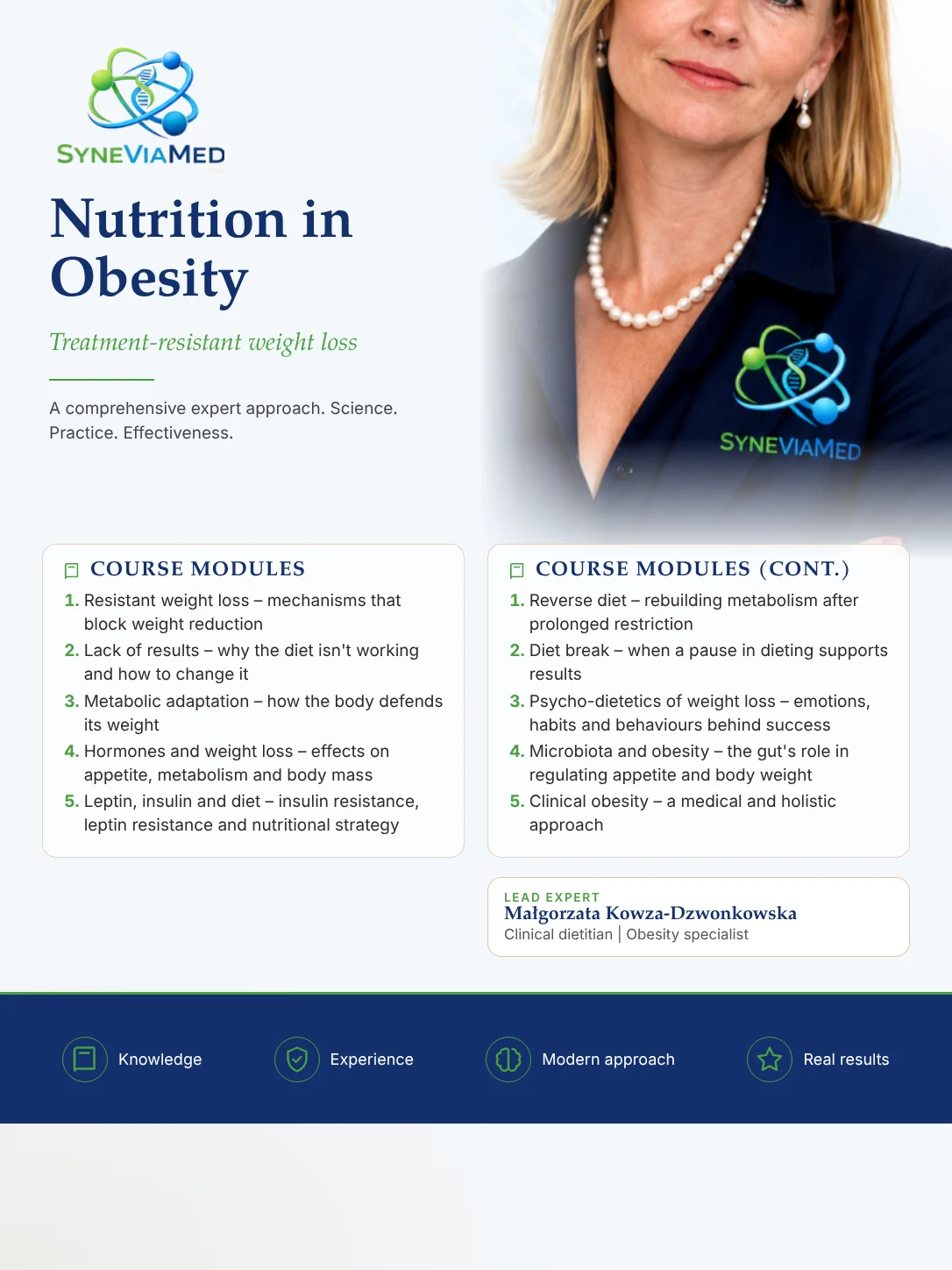
Treatment-Resistant Obesity – A Clinical Approach
Leave feedback on the product

Shipping costs are not included in the price.
Shipping costs are not included in the price.
Ask about the product

The controller of your personal data is SyneViaMed. We process your data solely to reply to your enquiry. For more information on how we process personal data, please see our Privacy Policy.
Share the product card



Description
We teach why a calorie deficit doesn’t always work – and what to do in practice.
This advanced nutrition course focuses on one of the hardest problems in modern practice: lack of weight loss despite dieting and a calorie deficit. The programme is based on current scientific evidence from physiology, endocrinology and nutritional psychology.
You will learn about mechanisms such as metabolic adaptation, hormonal disorders, the influence of the gut microbiota and psychological factors that can block weight loss. The course teaches a practical clinical approach that goes beyond “eat less, move more”.
Content is based on publications in endocrinology and position statements of The Obesity Society, among others.
The course takes an interdisciplinary approach focused on solving problems and restoring normal biological function. Our goal is nutrition therapy with lasting results.
Course programme
Module 1. Why you’re not losing weight
- metabolic adaptation (slowed metabolism)
- errors in calorie counting and NEAT
- the role of resting energy expenditure
Hall et al., 2016: a drop in energy expenditure can persist long term.
Module 2. Hormones and body weight
- insulin and insulin resistance
- leptin and leptin resistance
- cortisol and stress
Sumithran et al., 2011: after weight loss, hormonal changes occur that increase appetite.
Module 3. The gut and inflammation
- the gut microbiota and metabolism
- chronic low-grade inflammation
- the effect of diet on gut flora
Turnbaugh et al., 2006: the microbiota may influence how efficiently energy is stored.
Module 4. Nutritional psychology
- binge eating
- chronic dietary restriction
- mechanisms of compulsive eating
Polivy & Herman, 1985: restrictive diets increase the risk of overeating.
Module 5. Treatment strategies
- reverse dieting (gradually increasing calories)
- diet breaks
- changing strategy instead of cutting calories further
- personalising the plan
Peos et al., 2021: diet breaks may help maintain results and improve metabolism.
Key takeaways
- a calorie deficit doesn’t always work in a linear way
- the body adapts to weight loss
- hormones and stress are crucial
- the gut and inflammation affect metabolism
- the mind is as important as the diet
Who is it for?
- dietitians
- personal trainers
- skin therapists working on body contouring
- anyone working with clients who are overweight or obese
Reviews
If you've added a review and it doesn't appear on the list, it may be pending moderation.
Leave feedback on the product


