
RF Devices – Expert Advice (price on request)
Leave feedback on the product

Shipping costs are not included in the price.
Shipping costs are not included in the price.
Ask about the product

The controller of your personal data is SyneViaMed. We process your data solely to reply to your enquiry. For more information on how we process personal data, please see our Privacy Policy.
Share the product card



Description
How to choose the right RF device for your clinic
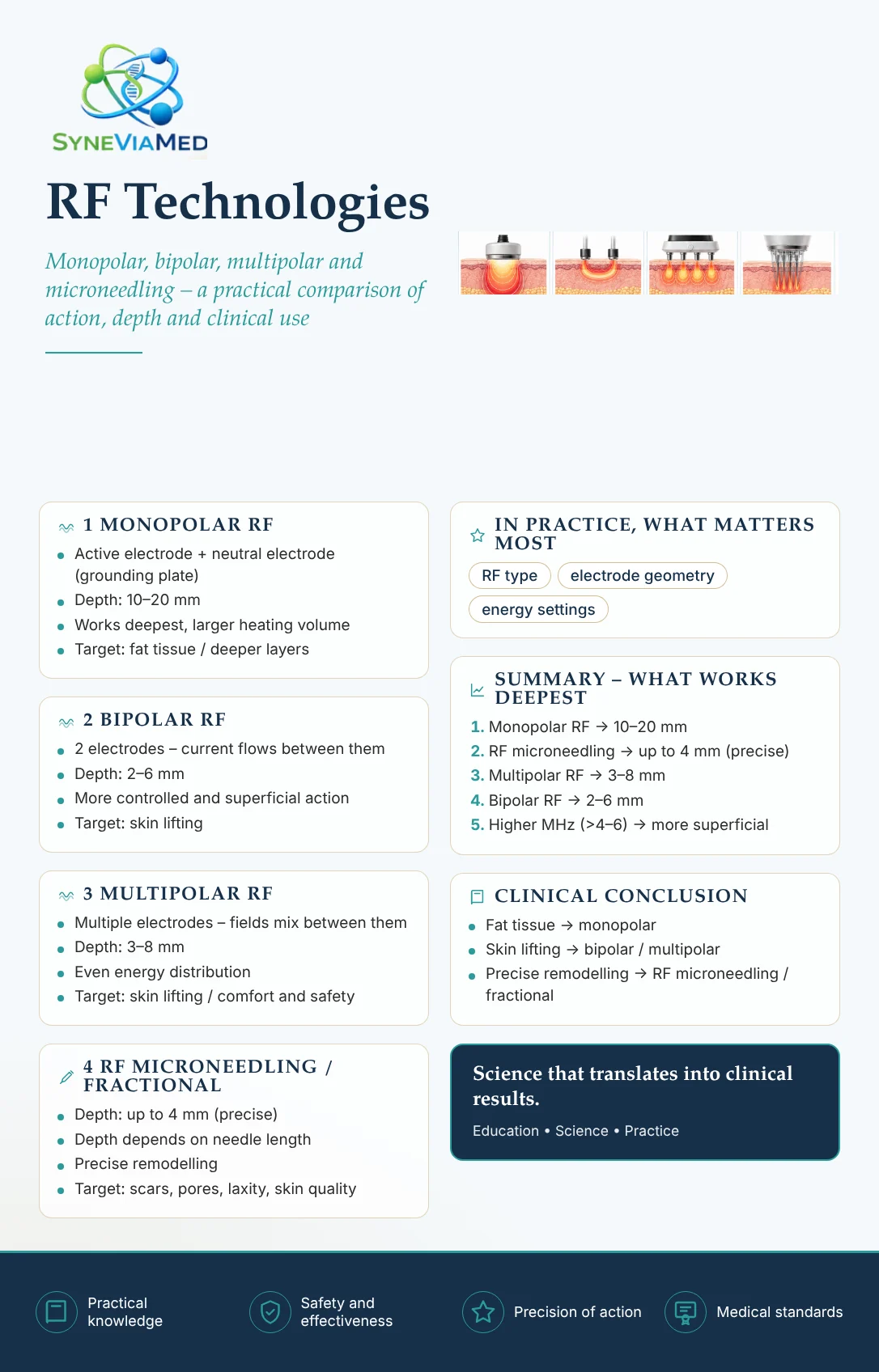
The most important thing is understanding how radiofrequency (RF) penetrates tissue. Let’s start by getting the physics straight, because it is key:
It is not the frequency (MHz) alone that determines depth, but:
- electrode configuration (monopolar vs bipolar vs multipolar)
- tissue resistance (impedance)
- power and pulse duration
- applicator geometry
- skin contact
Frequency matters, but it is secondary to the layout of the electric field.
RF works through: current flow → tissue resistance → heat generation (the Joule effect).
It is not a wave that “penetrates like a laser” but an electric field between electrodes.
The effect of frequency (MHz) on depth
General physical rule:
- lower frequency → deeper penetration
- higher frequency → more superficial action
Monopolar RF – works the DEEPEST
Mechanism:
- current flows between the active electrode and a neutral (return) electrode, e.g. under the back
Caution:
A very large volume of tissue is affected – the wrong tissues are very often overheated, which can damage them. The biggest problem is damage to the facial fat pads, which ultimately accelerates facial ageing! MONOPOLAR RF SHOULD NOT BE USED ON THE FACE!
Depth:
- up to 15–25 mm
- in aesthetic practice: 10–20 mm
What it reaches:
- dermis
- fat tissue
- partly fascia
Conclusion: monopolar RF = the DEEPEST penetration
Bipolar RF – shallower and controlled
Mechanism:
- current flows between two electrodes in the handpiece – the energy stays local
Depth:
about half the distance between the electrodes – typically 2–6 mm, maximum ~8 mm
What it reaches:
- epidermis
- dermis
- superficial SMAS
Conclusion: more precise depth, safer for the face
Multipolar RF
Mechanism:
- multiple electrodes → alternating field
Effect:
- more even energy distribution
Depth:
- 3–8 mm, depending on configuration
Microneedling / fractional RF
Here is the exception to the frequency rule: depth = needle length.
Typical values:
| Needle depth | Effect |
|---|---|
| 0.5–1 mm | superficial skin |
| 1–2 mm | dermis |
| 2–4 mm | deep layers |
| 3–4 mm | subcutaneous tissue |
RF frequency (e.g. 1–2 MHz) does not determine depth here – the needle does.
The most common mistake
- “Higher frequency = deeper” → FALSE
- “MHz determines depth” → a marketing simplification
In practice, what matters most is:
- the type of RF
- electrode geometry
- energy settings
Summary – what works deepest
Depth ranking:
- Monopolar RF → 10–20 mm
- Microneedling RF (deep settings) → up to 4 mm (precisely)
- Multipolar RF → 3–8 mm
- Bipolar RF → 2–6 mm
- High MHz (>4–6) → superficial
Clinical conclusion
- fat tissue → monopolar
- skin lifting → bipolar / multipolar
- precise remodelling → microneedling / fractional RF
Reviews
If you've added a review and it doesn't appear on the list, it may be pending moderation.
Leave feedback on the product


