
Nutritional Psychology – Emotional Eating & Eating Disorders
Leave feedback on the product

Shipping costs are not included in the price.
Shipping costs are not included in the price.
Ask about the product

The controller of your personal data is SyneViaMed. We process your data solely to reply to your enquiry. For more information on how we process personal data, please see our Privacy Policy.
Share the product card



Description
The course responds to one of the most important market trends: clients increasingly don’t need another meal plan – they need a specialist who will help them understand why they eat when they are not hungry, why they keep returning to restriction and bingeing, and how to regain a calm, healthy relationship with food and their body.
Emotional eating and eating disorders are not simply a matter of “lack of willpower”, but a complex interaction of emotions, stress, environment, habits and appetite regulation. A well-designed nutritional psychology intervention can help reduce emotional eating, improve control over eating and achieve better long-term results – especially when changing how someone eats is combined with work on the psychological mechanisms.
Course programme
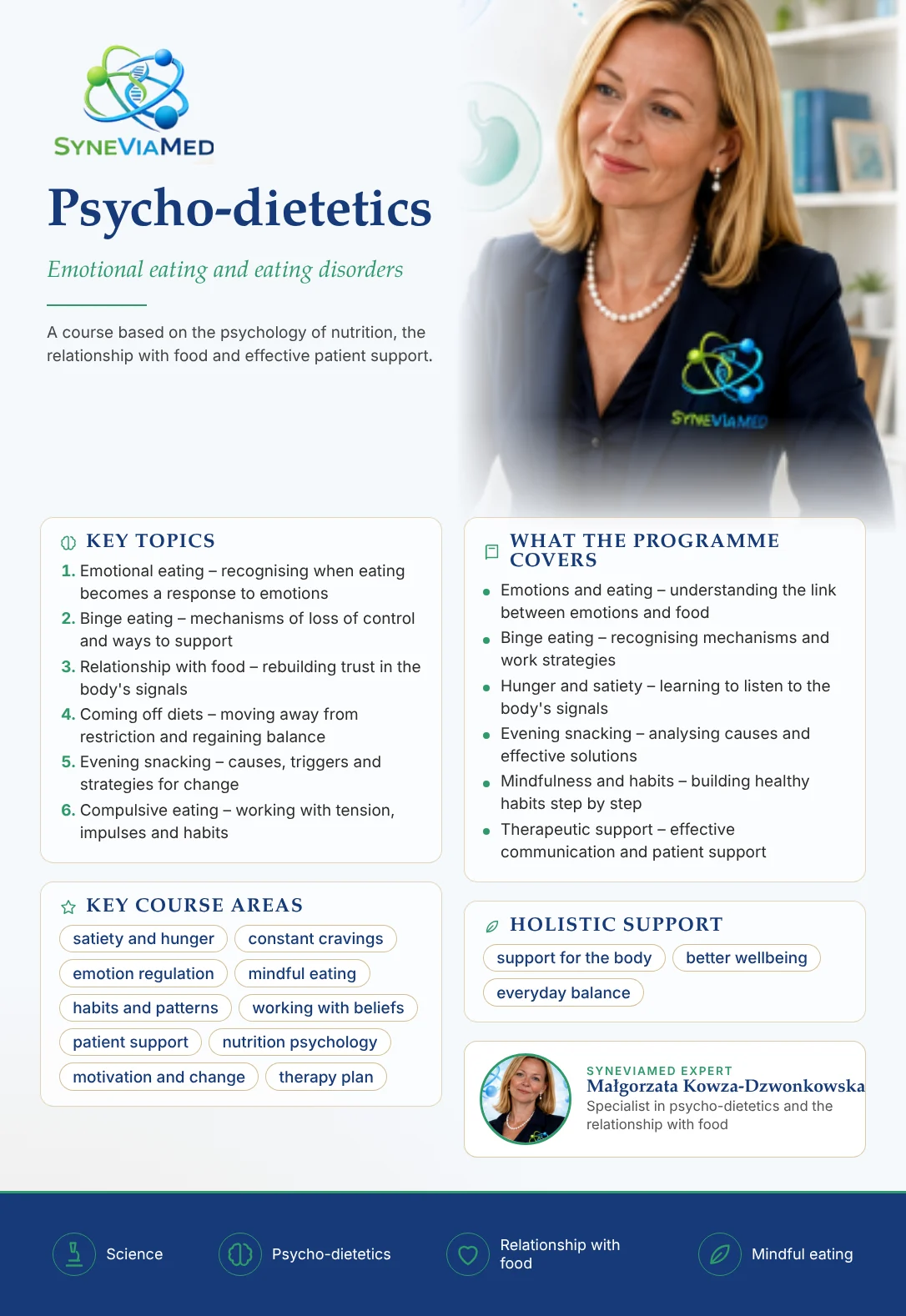
1. Foundations of nutritional psychology
- how nutritional psychology differs from classic dietetics
- the biopsychosocial model of eating behaviour
- the role of emotions, stress, habits and environment
- eating as a way to regulate tension, reward and relief
2. The relationship with food
- how a disordered relationship with food develops
- food as control, punishment, reward and comfort
- stress, cortisol and highly palatable food
- hunger, fullness and body signals
- beliefs about food, the body and “being on a diet”
- tools: emotion diary, trigger map, hunger and fullness scale
3. Emotional eating
- definitions and mechanisms of emotional eating
- the difference between emotional, compulsive and binge eating
- when restriction increases bingeing
- effective interventions for emotional eating
4. Eating disorders
- anorexia, bulimia, BED and the transdiagnostic picture
- warning signs in nutrition practice
- red flags and when to refer to a mental health professional
- the dietitian’s role in supportive treatment
5. Motivation and behaviour change
- working with ambivalence
- motivational interviewing in nutrition consultations
- talking to clients without shaming (self-compassion instead of shame)
- elements of CBT: automatic thoughts, beliefs, relapse work
- ACT: accepting emotions, values, psychological flexibility
- mindfulness and mindful eating
- setting goals and change plans
- building readiness for change without pressure
- what research shows about MI/MET in eating disorders
- basics of interdisciplinary work: psychologist, dietitian, skin therapist, trainer, therapist, doctor
6. Nutritional psychology tools
- food and emotion diary
- trigger analysis
- working with automatic thoughts
- meal planning without excessive restriction
- interventions that support self-regulation and self-monitoring
7. Clinical nutrition in the background
- how to plan nutrition that stabilises hunger and fullness
- managing deficiencies and irregular meals
- the role of protein, fibre, regularity and diet quality
- how to avoid harm from excessive “healthy” restrictions
8. Working with clients in practice
- nutritional psychology consultation and consultation protocol
- assessing the risk of eating disorders
- conversation scenarios, working agreement
- a 4–12-week work plan, monitoring progress
- documentation and legal safety
- scope of practice and interdisciplinary cooperation
Case studies
- a client who binges, e.g. on sweets in the evening
- a client after many diets and the yo-yo effect
- a person who binge eats compulsively after stress
- a teenager comparing her body on social media
- a client with orthorexia and fear of “unclean food”
- a person after aesthetic treatments with a strong focus on appearance
Benefits
- You will learn to recognise the mechanisms behind emotional eating and a disordered relationship with food.
- You will gain practical tools for working with clients who binge, eat compulsively or feel strong ambivalence.
- You will better distinguish situations where a nutrition intervention is enough from those that require a psychotherapist or psychiatrist.
- You will learn to lead conversations without pressure, shame or excessive control.
- You will build more effective, safer recommendations for people who struggle with classic weight-loss diets.
- You will expand your practice with a highly sought-after skill – evidence-based nutritional psychology.
Who is it for?
This course is for dietitians, nutritional psychologists, psychologists, therapists, health coaches and professionals working with clients who struggle with control over eating, emotional eating or entrenched dieting patterns. It is also suitable for those who want to work more clinically and safely with clients showing symptoms of eating disorders.
FAQ
Is the course only about eating disorders?
No. It also covers the relationship with food, emotional eating, compulsive snacking, working with hunger and fullness, and elements of behaviour change.
Is the course more psychological or nutritional?
It is interdisciplinary. It combines clinical nutrition, the psychology of change and practical tools for working with clients, because research shows that a purely nutritional model is usually not enough.
Does the course teach how to work with clients with BED or bulimia?
Yes, within the scope of a nutrition professional. The course shows how to recognise warning signs, how to support the client and when referral to a psychotherapist or psychiatrist is necessary.
Will there be tools for clinical practice?
Yes. The programme includes practical tools: the nutritional psychology consultation, trigger analysis, working with ambivalence, diaries and frameworks that support habit change.
Is the course evidence-based?
Yes. The programme is built on current reviews and meta-analyses on emotional eating, BED treatment, motivation for change and the effectiveness of behavioural interventions.
Sign up and learn to support change in people’s relationship with food in a clinical, safe and evidence-based way. Start now and build the skills clients really need today.
Reviews
If you've added a review and it doesn't appear on the list, it may be pending moderation.
Leave feedback on the product


