
Nutrition for Thyroid Conditions – Hashimoto’s & Hypothyroidism
Leave feedback on the product

Shipping costs are not included in the price.
Shipping costs are not included in the price.
Ask about the product

The controller of your personal data is SyneViaMed. We process your data solely to reply to your enquiry. For more information on how we process personal data, please see our Privacy Policy.
Share the product card



Description
This specialist course focuses on practical nutrition therapy for thyroid conditions, with particular attention to Hashimoto’s and hypothyroidism. The programme goes beyond “TSH within range” and focuses on real improvement in how the client feels: reducing inflammation, improving energy, gut function and weight control.
The course is based on current research in endocrinology and clinical nutrition, as well as recommendations from the American Thyroid Association.
Wiersinga et al., 2012: Hashimoto’s is an inflammatory, immune-based disease requiring a multifactorial approach. Virili et al., 2019: gut disorders can affect medication absorption and thyroid function.
Course programme
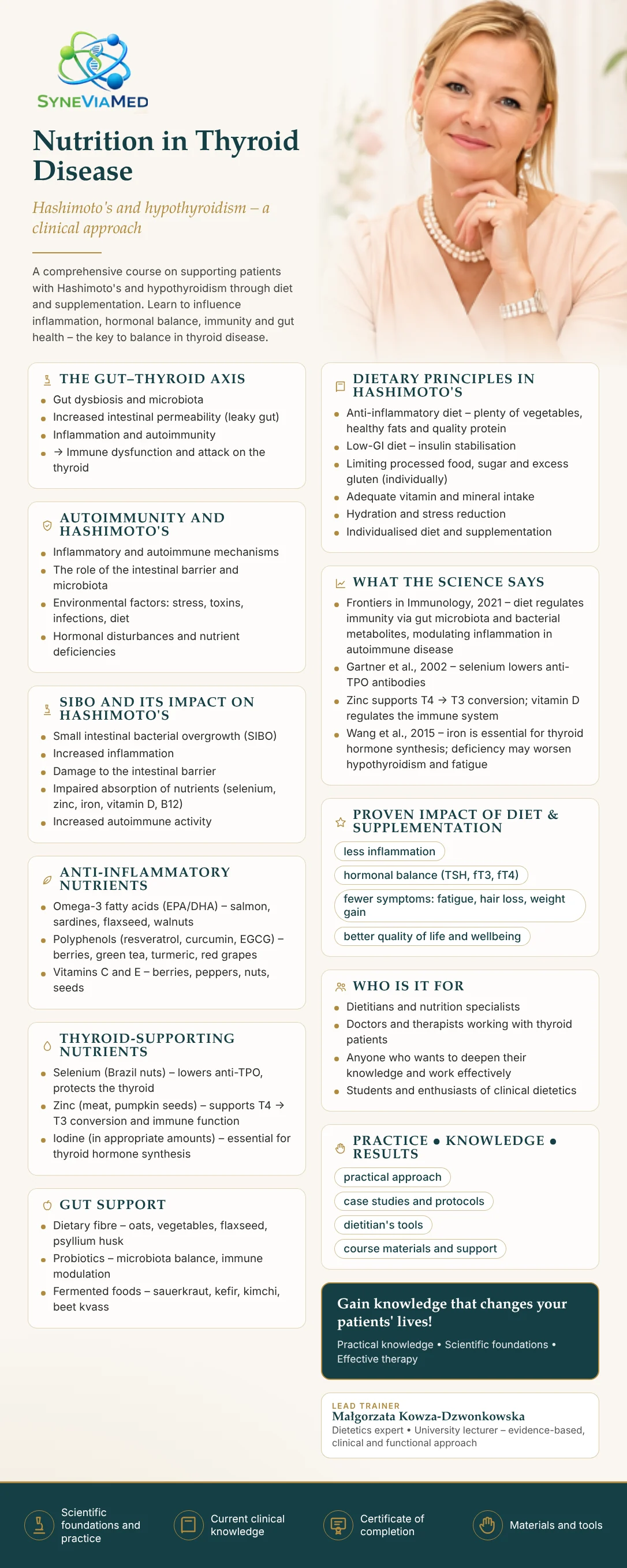
Module 1. Autoimmunity and Hashimoto’s
- inflammatory and autoimmune mechanisms
- the role of the gut barrier
- environmental factors
Fasano, 2012: increased intestinal permeability may be key in autoimmune diseases.
Module 2. Clinical diagnosis
- TSH, FT3, FT4
- anti-TPO and anti-TG antibodies
- interpreting results in practice
- the difference between the “lab range” and the client’s clinical condition
Module 3. Anti-inflammatory diet
- the Mediterranean diet model
- eliminations (gluten, lactose – when they make sense)
- stabilising blood sugar
Nutrients, 2020: an anti-inflammatory diet may reduce autoimmune symptoms.
Module 4. The gut and microbiota
- the gut–thyroid axis
- intestinal permeability (leaky gut)
- SIBO and its effect on Hashimoto’s
Virili et al., 2019: SIBO can impair levothyroxine absorption.
Module 5. Evidence-based supplementation
To lower anti-TPO, support T4 → T3 conversion, regulate the immune system and provide what is needed for thyroid hormone synthesis.
When supplements do harm
- excess iodine
- uncontrolled selenium supplementation
- interactions with medication
Module 6. Body weight and metabolism
- “I’m not losing weight despite dieting”
- metabolic adaptation
- the effect of thyroid hormones on metabolism
Rosenbaum & Leibel, 2010: the body adapts to an energy deficit.
Active dietary components with therapeutic effects
Anti-inflammatory
Thyroid-supporting
Gut-supporting
Frontiers in Immunology, 2021: diet influences immune regulation through the microbiota.
Key takeaways
- Hashimoto’s is a systemic disease, not just a thyroid disease
- the gut plays a central role
- diet can genuinely reduce symptoms
- supplementation must be targeted, not “blind”
Reviews
If you've added a review and it doesn't appear on the list, it may be pending moderation.
Leave feedback on the product


