
Nutrition for PCOS (Polycystic Ovary Syndrome)
Leave feedback on the product

Shipping costs are not included in the price.
Shipping costs are not included in the price.
Ask about the product

The controller of your personal data is SyneViaMed. We process your data solely to reply to your enquiry. For more information on how we process personal data, please see our Privacy Policy.
Share the product card



Description
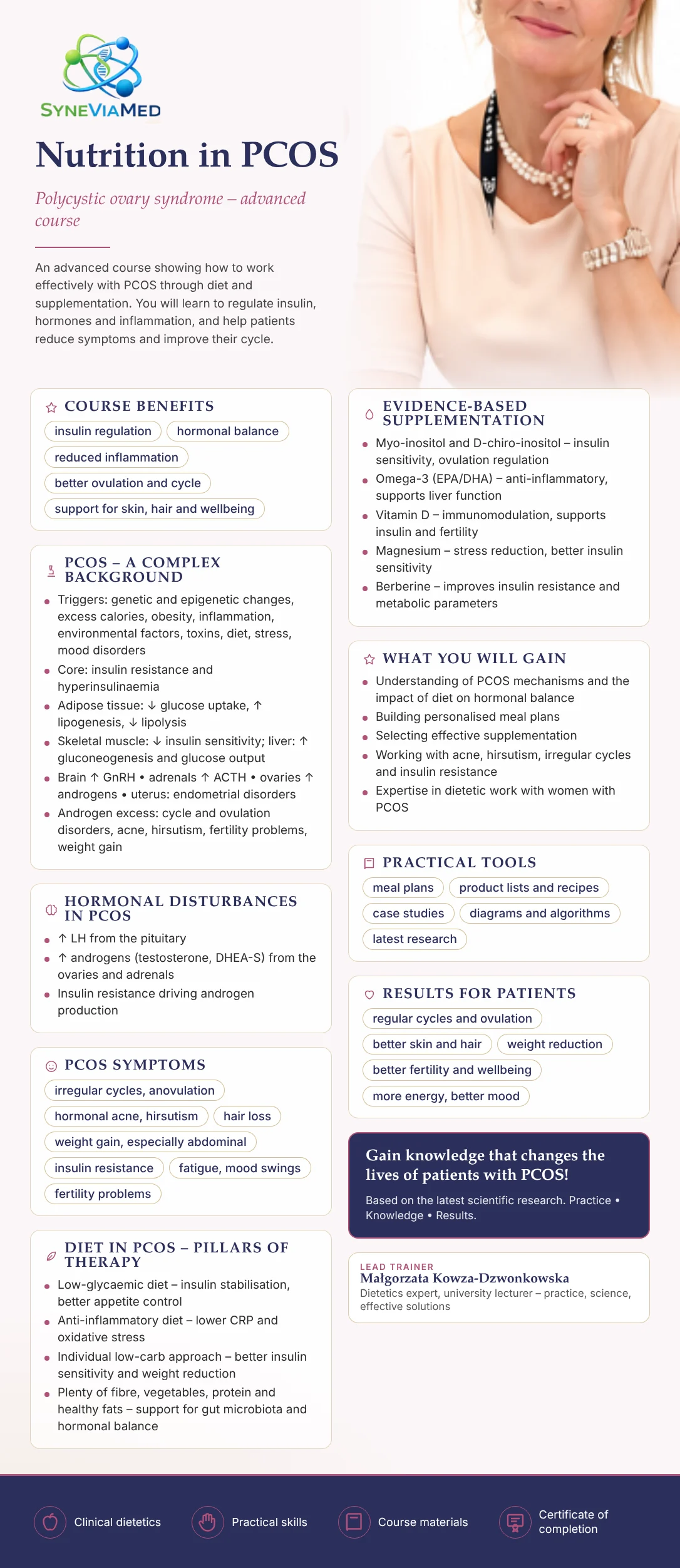
Specialist training for dietitians working with women with PCOS, approached as a complex hormonal-metabolic disorder in which insulin resistance, hyperandrogenism and chronic inflammation play a key role.
The programme is based on current recommendations from the Endocrine Society and the European Society of Human Reproduction and Embryology.
Teede et al., 2018: lifestyle, including diet, is the foundation of PCOS treatment. Moran et al., 2013: a low-GI diet improves insulin sensitivity and metabolic parameters.
Course programme
Module 1. PCOS – pathophysiology
- disorders of the hypothalamic–pituitary–ovarian axis
- insulin resistance as the main mechanism
- hyperandrogenism (testosterone, DHEA)
- inflammation and oxidative stress
Diamanti-Kandarakis & Dunaif, 2012: insulin increases androgen production.
Module 2. Diagnosis and interpreting results
- the Rotterdam criteria
- hormones: LH, FSH, testosterone, SHBG
- glucose, insulin, HOMA-IR
- lipid profile, CRP
- “clinical” interpretation, not just laboratory ranges
Module 3. Diet in PCOS – the foundation of treatment
The most effective models:
Low-glycaemic-index diet
- stabilising insulin
- improving ovulation
Anti-inflammatory diet
- reducing CRP and oxidative stress
Low-carb approach (individually)
- improving insulin sensitivity
Gower et al., 2013: a low-carb diet improves the hormonal profile in women with PCOS.
Module 4. Insulin regulation – the key to treatment
- meal timing
- glycaemic load
- the role of protein and fat
Dunaif, 1997: insulin resistance occurs in most women with PCOS.
Module 5. Active dietary components (evidence-based)
Nutrients that improve ovulation and insulin sensitivity, act as anti-inflammatories, improve the lipid profile, influence insulin and ovarian function, and support the skin (acne) and hormonal balance.
Module 6. The gut and inflammation
- the microbiota and PCOS
- metabolic endotoxaemia
- the effect of diet on the gut
Reviews
If you've added a review and it doesn't appear on the list, it may be pending moderation.
Leave feedback on the product


