Nutrition & Supplements for Acne
Leave feedback on the product

Shipping costs are not included in the price.
Shipping costs are not included in the price.
Ask about the product

The controller of your personal data is SyneViaMed. We process your data solely to reply to your enquiry. For more information on how we process personal data, please see our Privacy Policy.
Share the product card



Description
Nutrition and supplements for acne – an evidence-based expert course
About the course
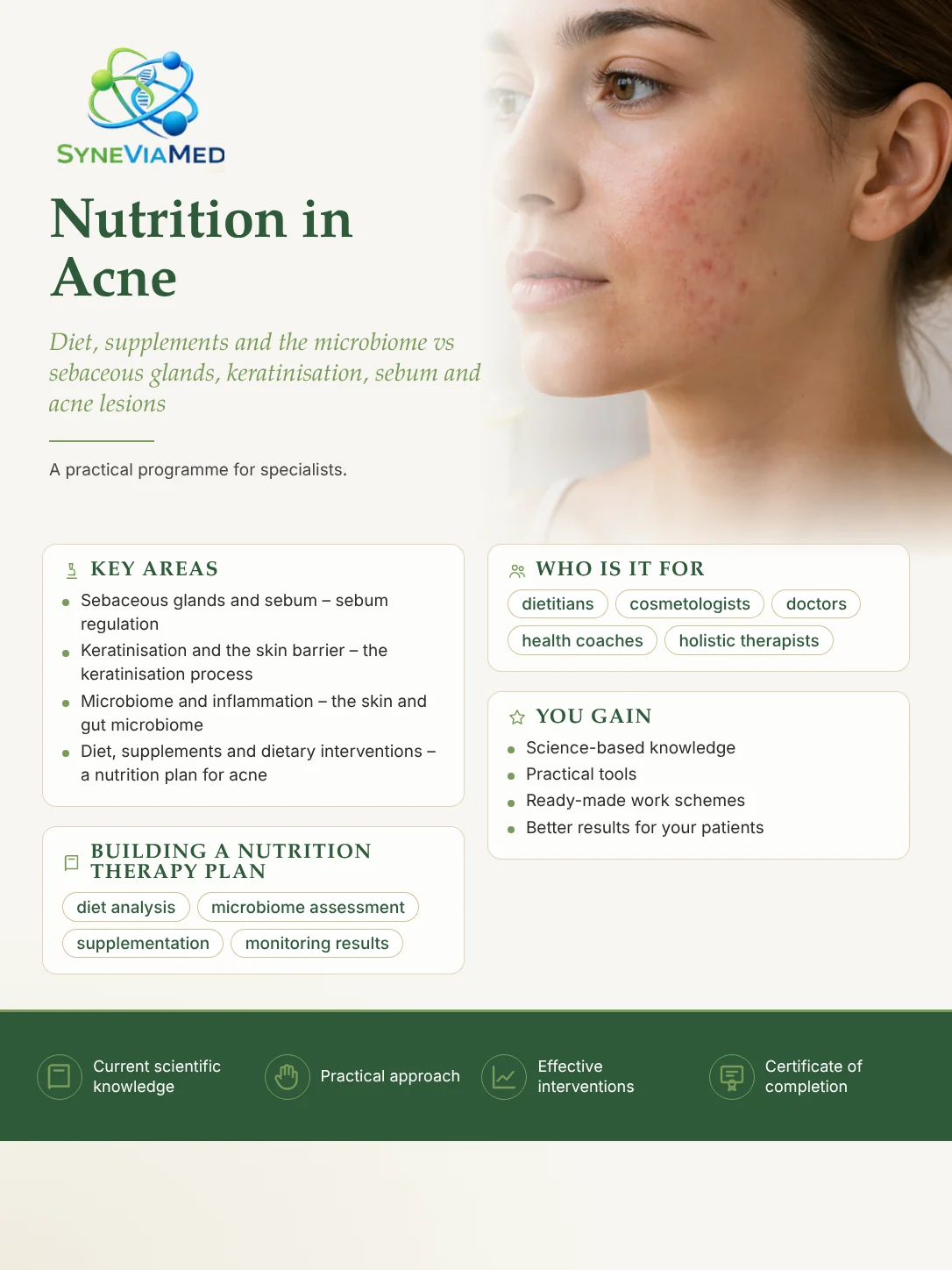
This course is designed for professionals who want to understand acne not only as a dermatological problem, but as a disorder involving the sebum–keratinisation–inflammation–microbiome–insulin/hormone axis. The programme organises current knowledge about when diet and supplements genuinely support treatment and when their role is only supportive. Particular emphasis is placed on teenage acne, adult female acne, acne with an insulin-resistance component, premenstrual flare-ups, highly inflammatory acne and resistant or recurrent cases.
You will learn how to link acne phenotypes with nutritional interventions that influence IGF-1, insulin, mTORC1, sebum composition, the gut and skin microbiome and the inflammatory response.
Key biological foundations
The course begins with the mechanisms that explain why treatment needs support. Acne is not just a “blocked pore”. It is a disease of the pilosebaceous unit involving excess sebum, abnormal keratinisation of the follicle opening, inflammation, microbiome changes and hormonal-metabolic influences. Newer research also highlights skin barrier dysfunction, innate immunity and sebum quality.
The best-documented nutritional interventions
The strongest evidence is for a low-glycaemic-load diet. You will learn how to compose meals that limit sharp glucose and insulin spikes, how to choose sources of carbohydrate, protein and fat, and how to plan a diet that supports the skin barrier without increasing inflammation. We also discuss the difference between a low-GI diet and a realistic, practical anti-acne model.
The second important area is dairy – especially skimmed milk – and eating patterns that increase exposure to insulinotropic and IGF-1 signals. The course also covers eating patterns that support blood sugar control, inflammation and the microbiome.
Supplements with the strongest or most promising evidence
- Omega-3 fatty acids are among the most promising complementary interventions.
- Zinc has a long history of use and moderately good data, especially in inflammatory acne.
- Probiotics are one of the most interesting areas of modern supplementation.
- Vitamin D is discussed with caution. Some studies show more frequent deficiency in acne patients and improvement after supplementation in those who are deficient – but we do not recommend routine supplementation for every case of acne.
- Lactoferrin and some multi-ingredient nutraceuticals are presented as a promising area, especially in mild to moderate acne and as support for standard treatment.
Hormonal acne, adult female acne and insulin resistance
A large part of the course covers adult female acne, including the phenotype linked to hyperandrogenism, PCOS, the menstrual cycle and insulin resistance. We discuss the differences between classic teenage acne and adult female acne, how to interpret symptoms that suggest a hormonal background and when further testing is needed. The course also shows how diet therapy can support treatment by improving blood sugar control, body weight and insulin sensitivity – while never replacing endocrine diagnosis.
Dietary mistakes covered
The course discusses in detail the most common mistakes that hinder treatment: a chronically high glycaemic load, irregular eating with sugar binges, too much ultra-processed food, poorly balanced elimination diets, reaching for supplements without assessing deficiencies, ignoring the possible role of dairy in some patients and combining supplements with medication in ways that reduce effectiveness – e.g. incorrect use of minerals with tetracycline antibiotics.
How the course combines natural support with dermatological treatment
The programme makes clear that in moderate and severe acne, diet and supplements are a supporting element. We discuss current treatment guidelines including benzoyl peroxide, topical retinoids, combination therapies, selected antibiotics, hormonal therapy and isotretinoin in the right indications.
We also look separately at situations where nutritional support is especially important: acne with metabolic features, alongside isotretinoin, poor tolerance of treatment, relapse after treatment, patients on restrictive diets and periods of increased stress and poor sleep.
Principles of an anti-acne diet
You will receive a practical model for planning menus: how to structure meals to limit insulin and inflammatory “spikes”, how to choose breakfasts, how to deal with snacking, how to plan the diet of women with PCOS-related acne and how to avoid deficiencies on elimination diets.
What you will be able to do after the course
You will be able to identify dietary and metabolic aggravating factors, propose sensible nutritional interventions, choose supplements according to the level of evidence and plan cooperation with a dermatologist, endocrinologist or gynaecologist when the problem goes beyond nutrition or skin-therapy competence.
Supporting publications
- Meixiong J, et al. Diet and acne: A systematic review. 2022.
- Ryguła I, et al. Impact of Diet and Nutrition in Patients with Acne Vulgaris. 2024.
- Raza Q, et al. Effect of a Low-Glycemic-Load Diet and Dietary Counseling... 2024.
- Smith RN, et al. The effect of a high-protein, low glycemic-load diet... 2007.
- Smith RN, et al. A low-glycemic-load diet improves symptoms in acne vulgaris. 2007.
- Smith RN, et al. The Effect of a Low Glycemic Load Diet on Acne Vulgaris and Sebum. 2008.
- Çerman AA, et al. Dietary Glycemic Factors, Insulin Resistance, and Acne. 2016.
- Burris J, et al. Differences in Dietary Glycemic Load and Hormones... 2017.
- Taha S, et al. The Mediterranean diet and acne vulgaris: a systematic review. 2025.
- Guertler A, et al. Exploring the potential of omega-3 fatty acids in acne patients. 2024.
- Jung GW, et al. Effect of dietary supplementation with omega-3 fatty acid and gamma-linolenic acid on acne vulgaris. 2014.
- Huang Y, et al. The adjuvant treatment role of ω-3 fatty acids... 2024.
- Mirnezami M, et al. Oral omega-3 and isotretinoin side effects. 2018.
- Göransson K, et al. Oral zinc in acne vulgaris. 1978.
- Verma KC, et al. Oral zinc sulphate therapy in acne vulgaris. 1980.
- Dreno B, et al. Minocycline vs zinc gluconate. 2001.
- Tolino E, et al. Oral zinc vs lymecycline. 2021.
- Eguren C, et al. Randomized clinical trial of an oral probiotic in acne. 2024.
- Randomized double-blind controlled probiotic trial. 2024.
- Jung GW, et al. Acne treatment regimen with and without probiotic supplement. 2013.
- Sutema IAMP, et al. Efficacy of probiotic supplements and topical applications. 2025.
- Meta-analysis of probiotics in acne vulgaris. 2025.
- Lin HW, et al. Systematic review and meta-analysis of randomized trials of oral probiotics. 2025.
- Warp PV, et al. Prebiotics, Probiotics, and Postbiotics for Acne Vulgaris. 2026.
- Wang M, et al. Vitamin D status and efficacy of vitamin D supplementation in acne vulgaris. 2021.
- Lim SK, et al. Comparison of Vitamin D Levels in Patients with and without Acne. 2016.
- Ruikchuchit T, et al. Vitamin D adjunct to topical benzoyl peroxide. 2024.
- Mohamed AA, et al. Active vitamin D administration in acne. 2021.
- Chan H, et al. Lactoferrin with vitamin E and zinc in mild to moderate acne. 2017.
- Mueller EA, et al. Oral lactoferrin supplementation in acne. 2011.
- Kim J, et al. Lactoferrin-enriched fermented milk and acne. 2010.
- Dreno B. Acne microbiome: From phyla to phylotypes. 2024.
- Vasam M, et al. Acne vulgaris: pathophysiology, treatment, and emerging therapies. 2023.
- Reynolds RV, et al. Guidelines of care for the management of acne vulgaris. 2024.
- Lipson J. Adult Female Acne: Managing the Hormones. 2024.
- Franik G, et al. Hormonal and metabolic aspects of acne vulgaris in women with PCOS. 2018.
- Szefler L, et al. Metformin Therapy for Acne Vulgaris: A Meta-Analysis. 2024.
- Telkkälä A, et al. Etiology of Adult Female Acne – Systematic Review. 2025.
Reviews
If you've added a review and it doesn't appear on the list, it may be pending moderation.
Leave feedback on the product


