Microneedling RF Training
Leave feedback on the product

Shipping costs are not included in the price.
Shipping costs are not included in the price.
Ask about the product

The controller of your personal data is SyneViaMed. We process your data solely to reply to your enquiry. For more information on how we process personal data, please see our Privacy Policy.
Share the product card



Description
Microneedling RF – treatment techniques, choosing tips and working safely
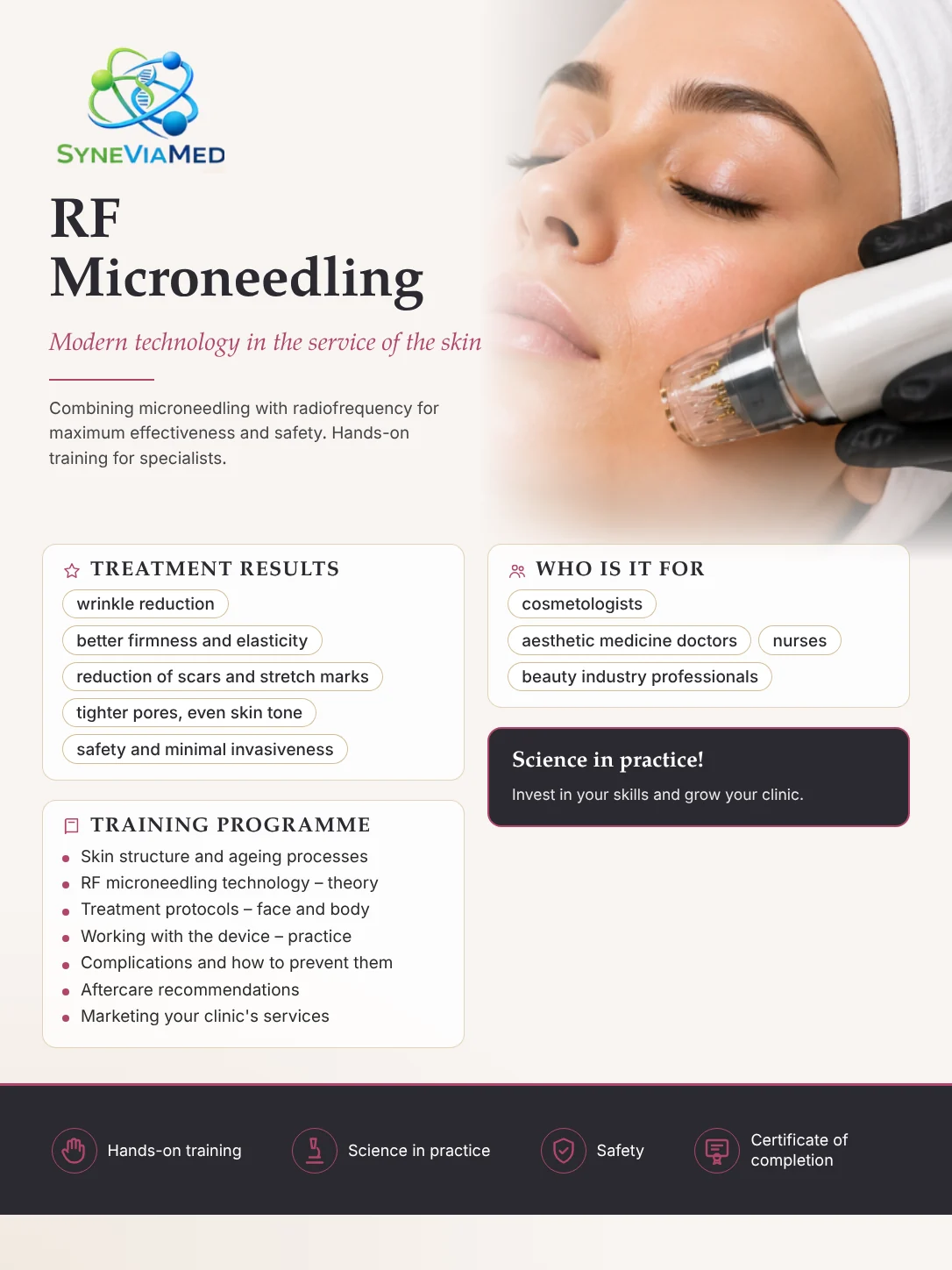
Course aim: to teach you to perform microneedling radiofrequency independently, confidently and safely. This technology combines microneedling with controlled heating of tissue using radio waves. You will learn the differences between monopolar and bipolar RF and between insulated, semi-insulated and non-insulated needles (including gold-plated ones), and how to choose the tip, depth, energy and number of passes for each indication.
Course content:
- How microneedling RF works – mechanical micro-injury, thermal coagulation in the dermis, collagen and elastin remodelling. The review by Chandra et al. describes fractional microneedling RF as non-ablative insertion of microneedles into the skin followed by controlled thermal coagulation, with short recovery time.
- Monopolar vs bipolar RF – monopolar RF usually gives a deeper, more diffuse thermal effect, while bipolar RF allows more controlled, localised energy distribution between electrodes. Modern devices such as Potenza combine monopolar and bipolar modes and 1 and 2 MHz frequencies in one system.
- Needles: gold-plated, insulated, semi-insulated and non-insulated – learn how energy emitted from the needle tip differs from emission along the whole needle. Insulated needles limit superficial overheating of the epidermis, while non-insulated needles can heat the entire channel more evenly. Secret RF/Secret PRO systems use tips with different needle configurations and adjustable depth.
- Treatment tips and cartridges – multi-needle tips, single tips, tips for spot treatment, multi-depth tips and tips for face and body. For example, Potenza offers Single Tip, Insulated Tip, Tiger Tip and Fusion Tip, and Morpheus8 Burst Deep uses a large 40-pin tip for bipolar energy.
- Indications – acne scars, enlarged pores, skin laxity, wrinkles, skin texture, stretch marks, photoageing. Split-face studies show that fractional microneedling RF is effective for acne scars, including in combination protocols, e.g. with subcision, poly-L-lactic acid or ablative fractional laser.
- Safety and contraindications – risks: burns, hyperpigmentation, scarring, infection, acne flare-ups, nerve damage and excessive volume loss with overly deep or aggressive treatment. The FDA stresses that microneedling RF should be treated as a medical procedure carried out by trained staff, given reported serious complications.
- Hands-on practice – client/patient assessment, consultation, consent form, photo documentation, disinfection, anaesthesia, parameter selection, treating each facial area, aftercare and managing complications.
Reviews
If you've added a review and it doesn't appear on the list, it may be pending moderation.
Leave feedback on the product


