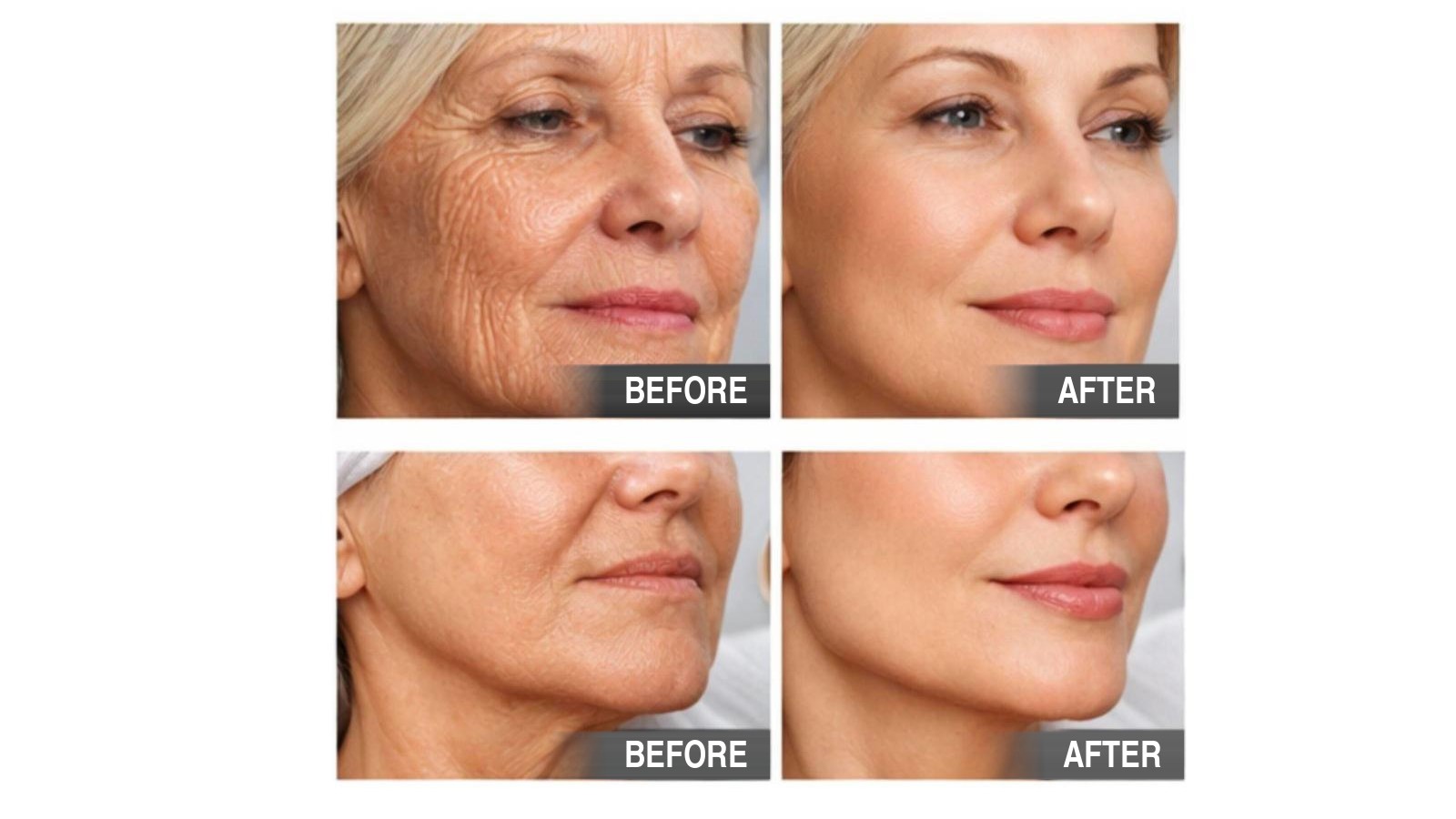
In treating laxity and poor skin quality, the best results are usually achieved not with a single treatment but with well-planned combination protocols that act on different tissue layers. Facial ageing simultaneously involves the skin, the extracellular matrix, the fascial system, the subcutaneous tissue and the muscles of facial expression. For this reason, modern treatment should be layered and anatomically targeted.
1. Microfocused ultrasound (HIFU / MFU-V)
Among modern non-surgical technologies, the best described for the deeper tissue layers is microfocused ultrasound. Systematic reviews and meta-analyses indicate that HIFU/MFU-V provides a moderate but clinically significant improvement in facial and neck rejuvenation. Its greatest advantage is the ability to act on the deeper supporting tissues without disrupting the epidermis. This is particularly important when the aim of therapy is not only to improve skin quality but also to influence the deeper supporting system of the face.
MFU-V works best in patients with mild to moderate laxity. In cases of advanced tissue descent, the efficacy of non-invasive methods is limited, and the highest efficacy is still shown by a surgical facelift.
2. Radiofrequency (RF)
Radiofrequency is one of the best-studied non-ablative technologies used to treat soft-tissue laxity. Systematic reviews indicate that both classic RF and fractional or microneedling technologies improve the features of facial skin ageing, primarily through collagen remodelling, neocollagenesis and improvement of the tissue scaffold within the dermis and the supporting layers.
Its advantage is the ability to treat patients with superficial laxity, reduced skin elasticity and thin skin of poor biological quality. In practice, RF complements HIFU well, because the two technologies work at different depths and through different mechanisms.
3. Neuromuscular electrical stimulation and microcurrents
In recent years, interest has grown in methods that act directly on facial muscle function. A study by Kavanagh et al. showed that a 12-week course of NMES (neuromuscular electrical stimulation) in healthy women was associated with increased thickness of the zygomaticus major muscle and subjective improvement in the features of facial ageing. More recent studies by Frank et al. indicated that combining synchronised radiofrequency with HIFES (high-intensity facial electrical stimulation) may increase the thickness of the zygomaticus major, enhance the EMG signal and improve midface volume. A separate study by the same group also reported improvement in forehead lines and lateral canthal lines, as well as brow elevation.
This is a promising direction, but caution is warranted in interpretation: compared with neuromodulators, lasers or HIFU, the evidence for aesthetic electrical stimulation is still less extensive and less well established. Therefore, NMES, microcurrents and related technologies should currently be regarded as a valuable adjunct to therapy, rather than a stand-alone gold standard.
4. Facial muscle exercises
Facial muscle exercises may be useful as part of functional prevention, rehabilitation and support of muscle tone, especially when performed systematically and correctly. They may improve control of facial expression, muscle awareness and the overall appearance of the face. Some studies also suggest that improved muscle activity may have a beneficial effect on microcirculation and tissue drainage, which may reduce oedema and improve the function of the superficial tissues.
It should be stressed, however, that the strength of evidence for facial exercises as a stand-alone anti-ageing therapy is limited. They are best seen as a supporting element rather than a first-line treatment for marked laxity or established signs of ageing.
Which therapies are most effective for each clinical problem?
If the dominant problems are dynamic wrinkles and overactivity of the muscles of facial expression, the strongest scientific evidence supports neuromodulators, because they act directly on the neuromuscular junction and reduce excessive muscle contraction.
If the problem is mild or moderate laxity and the patient expects non-surgical treatment of the deeper tissues, the best-justified option is microfocused ultrasound (HIFU/MFU-V). When superficial skin laxity and deterioration in skin quality also predominate, RF is also a very good choice, especially with fractional or microneedling technologies.
If the goal is improving muscle tone without injections, one may consider NMES, microcurrents, EMS, as well as certain supporting methods such as light, infrared or taping. It should be remembered, however, that the evidence for these methods is generally weaker than for neuromodulators, HIFU or RF.
Fractional lasers and resurfacing
Fractional lasers remain among the most effective methods when the main problems are static wrinkles, skin roughness, photoageing and texture irregularities. In a prospective study by Badawi et al., a non-ablative long-pulse Er:YAG 2940 nm laser improved static wrinkles and periorbital laxity, with adverse effects limited mainly to transient erythema, oedema and superficial peeling.
Randomised data are also available for more intensive fractional CO₂ resurfacing. In a study by Wu et al., ablative fractional CO₂ effectively reduced static periorbital wrinkles, with the best results achieved at lower energy and higher coverage density. The authors also noted that adding hydroquinone reduced the incidence of post-inflammatory hyperpigmentation (PIH).
Does synergistic combination of treatments give better results?
In the light of current literature, the answer is: very often, yes, provided the patient is properly qualified and the therapies are performed in the right order.
Microneedling RF + polynucleotides
This combination is justified when we want to simultaneously remodel thin skin and improve its biological quality and regeneration. Data indicate that such a protocol may deliver faster and more complete improvement than microneedling RF alone.
HIFU + bipolar RF
This is a good combination when laxity and loss of firmness predominate, but superficial wrinkles and deterioration in skin quality are also present. HIFU and RF complement each other in terms of depth of action and mechanism of effect.
Fractional laser + vitamin C / growth factors in the LADD model
This approach can be beneficial when the dominant problems are static wrinkles, photodamage and uneven texture, and the aim is to increase the penetration of selected substances after the treatment. This approach has a sound biological rationale, although it requires careful selection of indications.
Fractional laser + PBM / LED
This combination is clinically very logical when we want gentler healing, reduced inflammation and support for remodelling after an ablative or non-ablative treatment.
Practical conclusion
Today, the best results come from layered treatment.
- If the problem mainly concerns the muscles of facial expression, neuromodulators have the strongest evidence.
- If the goal is to improve deeper tissue firmness, HIFU/MFU-V is the best-justified option.
- If the dominant problems are skin laxity and a deteriorating collagen scaffold, RF holds a very strong position.
- If the main problems are static wrinkles and photoageing, among the most effective methods are still fractional lasers and resurfacing.
- Electrical stimulation, microcurrents and facial muscle exercises can be valuable support, but at present they should be regarded rather as an adjunct to the main therapies.
Małgorzata Kowza-Dzwonkowska
University lecturer, cosmetologist, dietitian, therapist, biomedical chemist
Training - HIFU in cosmetology (MHIFU, 12D HiFU)
Training - Fractional Lasers in Cosmetology
Training - RF Treatment Expert
Training - Synergistic Combination Therapies: Lifting Without a Scalpel
Training - Tissue Biostimulators + Mesotherapy and Microneedling
Training - Chemical Peels and Combination Therapies
References
Kavanagh, S., Newell, J., Hennessy, M., Sadick, N. (2012). Use of a neuromuscular electrical stimulation device for facial muscle toning: a randomized, controlled trial. Journal of Cosmetic Dermatology, 11(4), 261–266. https://doi.org/10.1111/jocd.12007
Frank, K., Kaye, K. O., Casabona, G., Glaue, E., Zeng, R., Lim, T. S., Brebant, V., Prantl, L., Moellhoff, N., Cotofana, S. (2025). Impact of Synchronized Radiofrequency and High-intensity Facial Electrical Stimulation on Facial Muscles and the Superficial Fascial System in the Midface. Aesthetic Surgery Journal, 45(4), 422–428. https://doi.org/10.1093/asj/sjae252
Cotofana, S., Fratila, A. A., Schenck, T. L., Redka-Swoboda, W., Zilinsky, I., Pavicic, T. (2016). The Anatomy of the Aging Face: A Review. Facial Plastic Surgery, 32(3), 253–260. https://doi.org/10.1055/s-0036-1582234
Hantash, B. M., Ubeid, A. A., Chang, H., Kafi, R., Renton, B. (2009). Bipolar fractional radiofrequency treatment induces neoelastogenesis and neocollagenesis. Lasers in Surgery and Medicine, 41(1), 1–9.
Manstein, D., Herron, G. S., Sink, R. K., Tanner, H., Anderson, R. R. (2004). Fractional photothermolysis: a new concept for cutaneous remodeling using microscopic patterns of thermal injury. Lasers in Surgery and Medicine, 34(5), 426–438.


