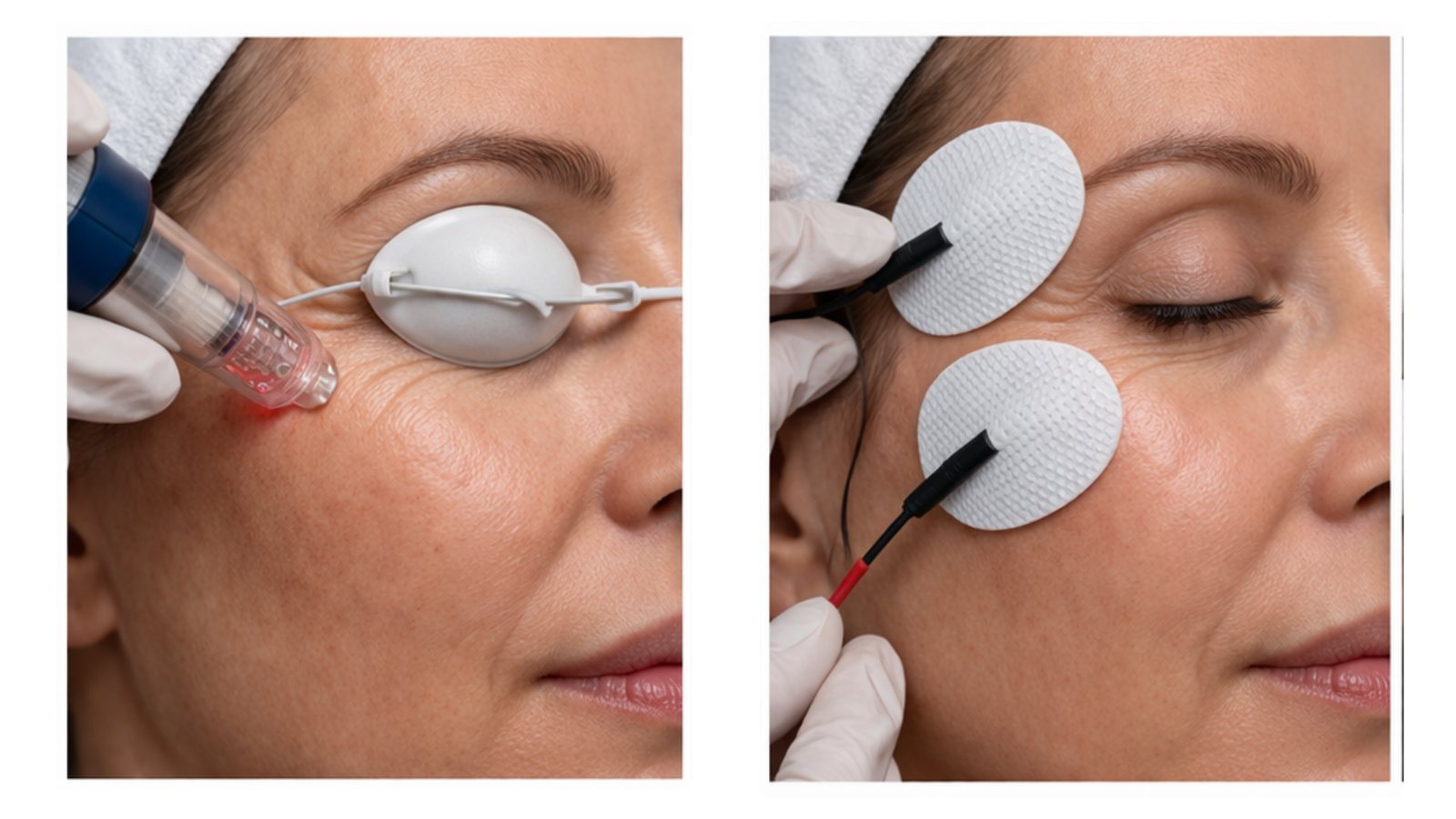
The skin around the eyes is among the thinnest in the body; it has a limited number of sebaceous glands, weaker tissue support and very intense activity of the orbicularis oculi muscle.
The ageing process in this area involves:
- thinning of the epidermis and dermis
- loss of collagen and elastin
- impaired microcirculation (dark circles, puffiness)
- laxity of the ligaments and fascia
- changes in the fat pads
- overactivity or weakening of the orbicularis oculi muscle
- ageing also affects the facial bones: the orbital apertures widen
The most effective approach in combination therapy
The best results are achieved by combining technologiesthat act on different layers:
- epidermis → improved quality and tone
- dermis → collagen stimulation
- vascular system → reduction of dark circles and puffiness
- muscles → regulation of tone
- deeper tissues → improved support
Technologies and treatments – what works, and for what?
1. Microneedling
Action:
- collagen induction (neocollagenesis)
- improved skin density
- enhanced penetration of active ingredients
Best indications:
- fine lines
- thin, lax skin
- dark circles under the eyes
Active ingredients:
- hyaluronic acid (hydration)
- biomimetic peptides
- growth factors
- vitamin C (with caution in this area)
Safety:
- depth usually 0.25–0.5 mm
- do not perform in the immediate vicinity of the eyelid margin
- sterility and a gentle technique are essential
2. Biostimulating laser (LLLT)
Action:
- improved cellular metabolism
- reduced inflammation
- improved microcirculation
Indications:
- vascular dark circles
- puffiness
- post-treatment regeneration
Advantage:✔ a very high safety profile
Eye safety:
- protective goggles are mandatory
- low energy → no thermal damage
3. Fractional laser (ablative / non-ablative)
Action:
- collagen remodelling
- improved skin structure
- wrinkle reduction
Most effective for:
- advanced wrinkles
- laxity
Safety:
- eyeball protection is essential (internal metal eye shields)
- precise energy settings
- risks: PIH, irritation, overheating
This is one of the most effective, but also most demanding, technologies.
4. HIFU (High-Intensity Focused Ultrasound)
Action:
- acts on the deeper layers (SMAS)
- lifting and tissue thickening
Effect:
- improved firmness
- a subtle lift of the eye area
Safety:
- use dedicated eye-area transducers
- avoid direct projection onto the eyeball
- perform only under ultrasound guidance
5. Radiofrequency (RF)
Action:
- heating of the dermis
- collagen stimulation
Types:
- classic RF
- microneedle RF
Effects:
- improved firmness
- reduction of fine lines
Safety:
- temperature control is crucial
- the eye area requires lower settings
6. Electrical stimulation of the orbicularis oculi muscle
Action:
- improved muscle tone
- restored balance between muscle fibres
Effects:
- reduced “bags”
- improved drainage
- better skin support
Technologies:
- EMS
- microcurrents
- TENS
Greatly underestimated, yet crucial in anti-ageing therapy.
Safety:
- appropriate current intensity
- avoiding impulses that irritate the eyeball
7. Manual therapies and massage
🔹 Lymphatic drainage
- reduction of puffiness
- improved circulation
🔹 Deep tissue massage
- improved tissue quality
- release of tension
🔹 Fascial therapy
- improved tissue glide
- influence on the SMAS
🔹 Face yoga
- regulation of muscle tone
Manual techniques are key, especially in cases of:
- puffiness
- muscle tone imbalances
- sluggish circulation
Modern and complementary methods
- cold plasma
- needle-free mesotherapy (electroporation, sonophoresis)
- exosomes and growth factors
- LED light therapies
Safety – key principles
The eye area is a high-risk zone.
Key principles:
- eyeball protection (goggles, metal shields for laser treatments)
- precise energy settings
- knowledge of anatomy
- avoiding overheating of the tissues
- caution with very thin skin
Possible complications of poorly performed or inappropriately selected treatments:
- irritation and oedema
- hyperpigmentation (PIH)
- thermal damage
- worsening laxity when the therapy is poorly chosen
The key to success is:
- the correct sequence
- appropriate intervals between treatments
- individual tailoring
Małgorzata Kowza-Dzwonkowska
University lecturer, cosmetologist, dietitian, therapist, biomedical chemist
We invite you to our training courses:
Training – HIFU in cosmetology (MHIFU, 12D HiFU)
Training – Fractional lasers in cosmetology
Training – RF treatment expert
Training – Synergistic combination therapies: lifting without a scalpel
Training – Tissue biostimulators + mesotherapy and microneedling


