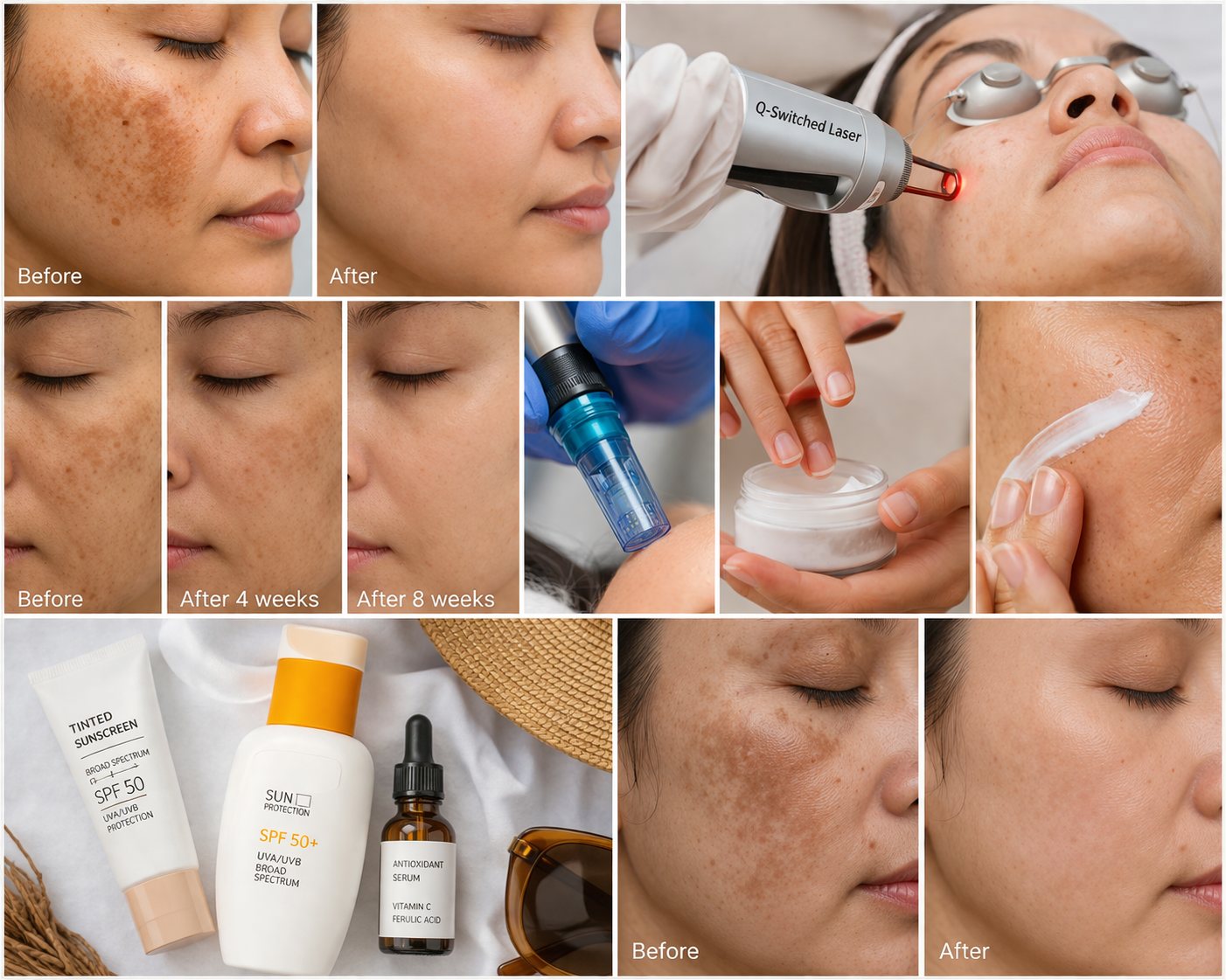
To treat melasma effectively, you need to understand its causes and the changes taking place in the tissues.
Melasma is not simply pigmentation caused by excess melanin – it involves a disorder of the entire skin environment.
What exactly is melasma?
Melasma is an acquired, chronic and relapsing hyperpigmentation, usually symmetrical and located on the face.
For years overactive melanocytes were thought to be the main problem. Today we know it is a far more complex process.
In skin affected by melasma, the following are observed:
- damage to the basement membrane,
- changes in the dermis (so-called solar elastosis),
- fibroblast activation,
- an increased number of mast cells (i.e. an inflammatory component),
- an increased number of blood vessels (neovascularisation),
- and changes in the extracellular matrix.
In other words, the problem concerns not only melanocytes but the entire structure of the skin [1–5].
What causes melasma?
The key point is that melasma results from the overlap of many factors.
The key ones include:
- light – not only UV but also visible light
- hormones – especially oestrogens (pregnancy, contraception)
- inflammation – including “silent”, chronic inflammation
- vascular factors
- skin photoageing
- genetic predisposition
In addition:
- contact dermatitis,
- aggressive aesthetic procedures,
- photosensitising cosmetics and medicines
can act as triggering or aggravating factors [1–3,5].
This explains why melasma tends to recur – it has many causes.
Key therapeutic takeaway
If the problem is multi-level,then you need to work on every level, in every layer where the problem appears.
That is why the best results come from combination treatments, not from a single procedure.
How to get rid of this hyperpigmentation? – a practical approach
Think of melasma therapy as a system built on four basic pillars.
- Photoprotection – the absolute foundation
Without it, treatments are pointless.
Most important:
- daily protection against UV + visible light (VL)
- gentle home skincare
No photoprotection =✔ poorer results✔ rapid relapses
This is one of the best-documented elements of therapy [3,5].
- Topical preparations – first-line therapy
The best-studied option is the so-called triple combination therapy:
- hydroquinone (HQ)
- tretinoin
- fluocinolone acetonide
It works on several levels at once:
- inhibits melanogenesis
- accelerates epidermal renewal
- reduces inflammation
It is the classic “gold standard” of initial therapy [6,7].
- Maintenance and adjunctive therapy
After the intensive treatment phase, we move on to stabilisation.
The most commonly used options:
- hydroquinone or cysteamine
- tranexamic acid
- acts on the plasmin–keratinocyte–melanocyte pathway
- reduces melanogenesis and the vascular component [9,10]
- azelaic acid
- a good alternative in cases of HQ intolerance [8]
This stage is crucial if we want to limit relapses.
- Treatments – as support, not the foundation
Technologies can help a great deal, but only when they are carefully selected.
Most commonly used:
- Q-switched Nd:YAG 1064 nm (low fluence)
- picosecond and alexandrite lasers
- fractional CO₂ lasers
- IPL
- microneedling, mesotherapy + active substances
- peels (especially glycolic acid) [11–15]
But NOTE – this is very important:
Overly aggressive treatments can worsen melasma
- strong peels
- high laser energy
- excessive irritation and inflammation
because they can lead to:
- post-inflammatory hyperpigmentation
- relapses
That is why the rule in melasma is always:treat effectively, but gently [5,11,12].
Why does combination treatment work best?
Because each method acts on a different element of the condition:
- photoprotection → removes the triggering stimulus
- topical treatment → inhibits melanocytes and inflammation
- systemic therapy, diet → act on biochemical and vascular pathways
- in-clinic treatments → help remove pigment
Only by combining them can you achieve effective, lasting results.
Scientific research clearly showsthat combination treatments are more effective than monotherapy [5–10].
Practical summary
Melasma is not a pigment problem.It is a problem of the skin environment.
Therefore:
- it is not enough to “brighten”
- you need to restore the skin’s balance
Become an expert in melasma therapy
At SyneViaMed training courses we teach:
- how to match treatments and active ingredients to the type of pigmentation and the phototype
- which concentrations of active ingredients are effective
- which treatment procedures to use
- when to introduce treatments and when to avoid them
- how to conduct therapy so that it works and does not cause relapses
- which additional treatments support tissue regeneration
Because effectiveness in melasma is not a matter of a single method.It is a matter of the therapist’s strategy.
We also invite you to our training courses:
Training – HIFU in cosmetology (MHIFU, 12D HiFU)
Training – Fractional lasers in cosmetology
Training – RF treatment expert
Training – Synergistic combination therapies: lifting without a scalpel
Training – Tissue biostimulators + mesotherapy and microneedling
Training – Chemical peels and combination therapies
Małgorzata Kowza-Dzwonkowska
University lecturer, cosmetologist, dietitian, therapist, biomedical chemist
Bibliography
- Handel, A. C., Miot, L. D. B., Miot, H. A. (2014). Melasma: a clinical and epidemiological review. Anais Brasileiros de Dermatologia, 89(5), 771–782.
- Grimes, P. E. (1995). Melasma. Etiologic and therapeutic considerations. Archives of Dermatology, 131(12), 1453–1457.
- Ortonne, J. P., Arellano, I., Berneburg, M., et al. (2009). A global survey of the role of ultraviolet radiation and hormonal influences in the development of melasma. Journal of the European Academy of Dermatology and Venereology, 23(11), 1254–1262.
- Kim, E. H., Kim, Y. C., Lee, E. S., Kang, H. Y. (2007). The vascular characteristics of melasma. Journal of Dermatological Science, 46(2), 111–116.
- Passeron, T., Picardo, M. (2018). Melasma, a photoaging disorder. Pigment Cell & Melanoma Research, 31(4), 461–465.
- Taylor, S. C., Torok, H., Jones, T., et al. (2003). Efficacy and safety of a new triple-combination agent for the treatment of facial melasma. Cutis, 72(1), 67–72.
- Torok, H. M., Jones, T., Rich, P., Smith, S., Tschen, E. (2005). Hydroquinone 4%, tretinoin 0.05%, fluocinolone acetonide 0.01%: a safe and efficacious 12-month treatment for melasma. Cutis, 75(1), 57–62.
- Baliña, L. M., Graupe, K. (1991). The treatment of melasma. 20% azelaic acid versus 4% hydroquinone cream. International Journal of Dermatology, 30(12), 893–895.
- Wu, S., Shi, H., Wu, H., et al. (2012). Treatment of melasma with oral administration of tranexamic acid. Aesthetic Plastic Surgery, 36(4), 964–970.
- Del Rosario, E., Florez-Pollack, S., Zapata, L., et al. (2018). Randomized, placebo-controlled, double-blind study of oral tranexamic acid in the treatment of moderate-to-severe melasma. Journal of the American Academy of Dermatology, 78(2), 363–369.
- Sarkar, R., Kaur, C., Bhalla, M., Kanwar, A. J. (2002). The combination of glycolic acid peels with a topical regimen in the treatment of melasma in dark-skinned patients: a comparative study. Dermatologic Surgery, 28(9), 828–832.
- Na, J. I., Choi, S. Y., Yang, S. H., Choi, H. R., Kang, H. Y., Park, K. C. (2010). Effect of low-fluence Q-switched Nd:YAG laser on melasma. Dermatologic Surgery, 36(5), 607–616.
- Wattanakrai, P., Mornchan, R., Eimpunth, S. (2010). Low-fluence Q-switched neodymium-doped yttrium aluminum garnet (1,064 nm) laser for the treatment of facial melasma in Asians. Dermatologic Surgery, 36(1), 76–87.
- Sarkar R, et al. Chemical Peels for Melasma: A Systematic Review. Dermatol Ther (Heidelb). 2024. PMID: 38530985.
- Sarkar R, Lakhani R. Chemical Peels for Melasma: A Systematic Review. Dermatol Surg. 2024


