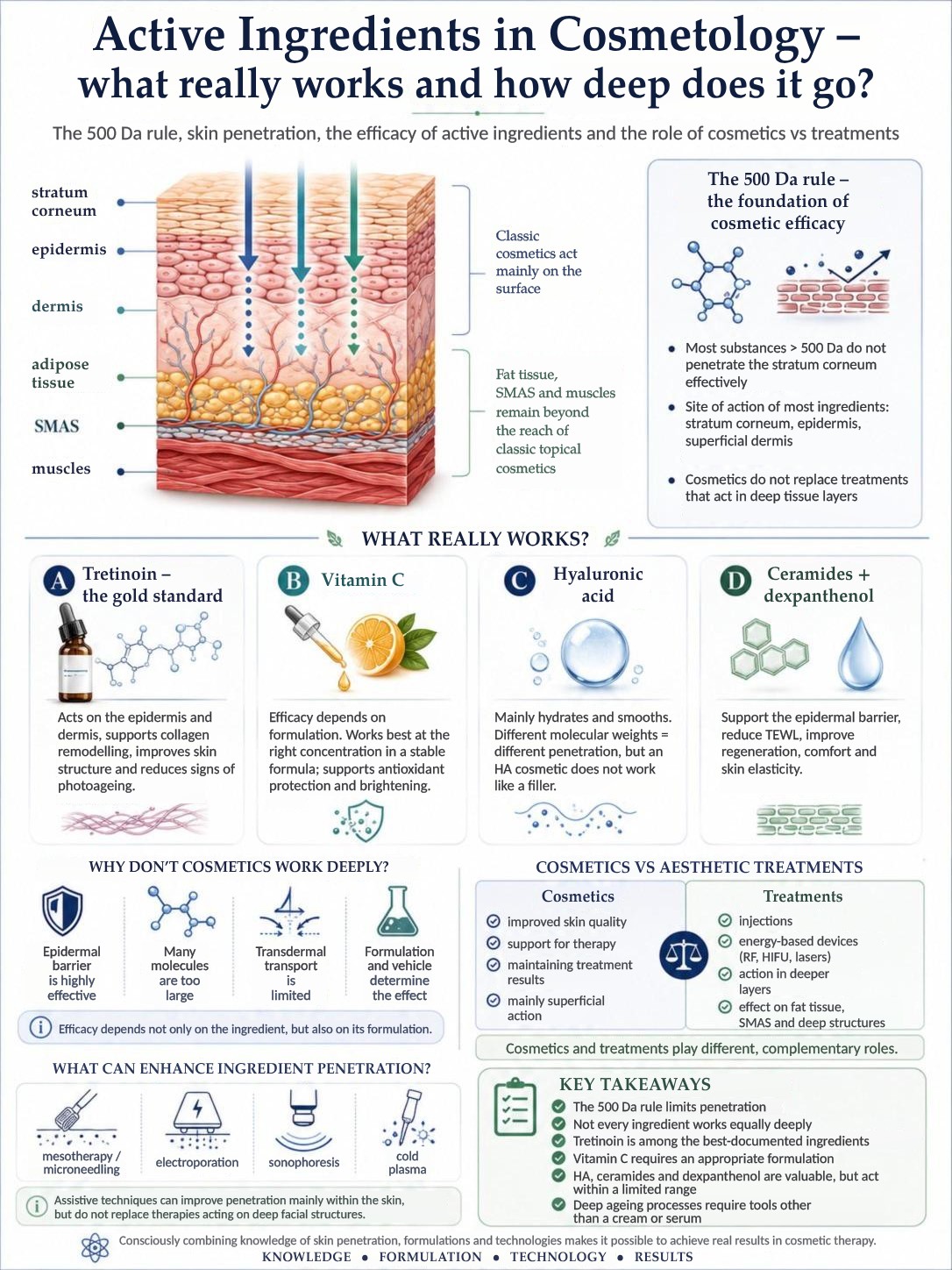
Active ingredients in cosmetology – what really works and how deep does it go?
Modern cosmetology is increasingly based on scientific evidence rather than marketing alone. One of the key issues is the question: do active ingredients really reach the places manufacturers promise?
The answer to this question begins with one of the most important concepts in dermatology and cosmetology – the so-called 500 Da rule.
The 500 Da rule – the foundation of cosmetic efficacy
According to the concept proposed by Bos and Meinardi, most substances with a molecular weight above 500 Daltons (Da) do not effectively penetrate the stratum corneum.
In practice, this means that:
- most cosmetic ingredients act superficially
- their main sites of action are:
- the stratum corneum
- the epidermis
- possibly the superficial dermis
By contrast, deep structures, such as:
- the dermis
- adipose tissue
- SMAS
- the mimetic muscles
remain beyond the reach of conventional topically applied cosmetics.
This is one of the most important practical conclusions: a cosmetic product cannot replace treatments that act in the deep tissue layers.
What can really work more deeply?
Although most ingredients act superficially, there are substances whose efficacy has been well documented.
Tretinoin – the gold standard in anti-ageing
Tretinoin (retinoic acid) is one of the most thoroughly researched ingredients in dermatology.
Studies show that it:
- affects the epidermis and dermis
- stimulates collagen remodelling
- improves skin structure
- reduces the signs of photoageing
It is an example of an ingredient that genuinely changes the architecture of the skin, not just its surface.
Vitamin C – efficacy depends on the formulation
Ascorbic acid can penetrate the skin, but only under certain conditions.
Studies (Lin et al.) show that it:
- works best at a concentration of around 15%
- requires stabilisation (e.g. vitamin E + ferulic acid)
- its efficacy depends on its form and vehicle
Practical conclusion:it is not just the ingredient but its formulation that determines the result.
Hyaluronic acid – facts and myths
Hyaluronic acid is one of the most popular cosmetic ingredients, but its action is often misinterpreted.
What does the science say?
- different molecular weights = different penetration
- low-molecular-weight HA can penetrate more deeply
- larger molecules act on the surface
What does this mean in practice?
- HA works mainly as a humectant (moisturiser)
- it improves skin hydration
- it smooths the surface
But:
- it does not have a volumising effect like fillers
- it does not reach deep structures
➡️ an HA cosmetic ≠ an HA treatment
Barrier ingredients – the foundation of healthy skin
Not all ingredients need to act deeply to be effective.
Dexpanthenol
Dexpanthenol:
- improves hydration
- reduces TEWL (transepidermal water loss)
- supports regeneration
Ceramides
- rebuild the hydrolipid barrier
- reduce skin sensitivity
- improve comfort and elasticity
Their role in anti-ageing
Their action is indirect:
- they improve the condition of the skin
- they reduce dryness and reactivity
But:
- they do not influence deep ageing processes
- they do not restore volume or structures (SMAS, ligaments, bone)
Why don't cosmetics work "deeply"?
From a scientific point of view, there are several reasons:
- the epidermal barrier is highly effective
- most molecules are too large
- transdermal transport is limited
Even enhancement techniques such as:
- microneedling
- laser-assisted delivery
- carriers (liposomes, nanoemulsions)
- mesotherapy, sonophoresis, electroporation, iontophoresis, RF, cold plasma
improve penetration mainly within the structures of the skin.
What really works on deep structures?
To act on:
- the dermis
- adipose tissue
- SMAS
- muscles
the following are used:
- injections
- mesotherapy, sonophoresis, iontophoresis, RF, cold plasma, electroporation
- energy-based technologies (RF, HIFU, lasers)
- surgical procedures
Here, cosmetics play a supporting rather than a replacing role.
The key takeaway for practice
Modern cosmetology should be based on a realistic approach:
- cosmetics are effective – but within a defined scope
- they act mainly on the skin surface
- their role is:
- improving skin quality
- supporting therapy
- maintaining treatment results
However:deep ageing processes require tools beyond simply applying a cream or serum
Summary
A conscious approach to active ingredients helps to avoid the most common mistake in cosmetology – overestimating what cosmetics can do.
Key facts:
- the 500 Da rule limits penetration
- efficacy depends on the formulation
- not every ingredient acts equally deeply
- cosmetics and treatments play different, complementary roles
It is understanding these principles that makes it possible to build effective, scientifically grounded skin therapies.
"A cosmetologist uses active ingredients, not cosmetics"


