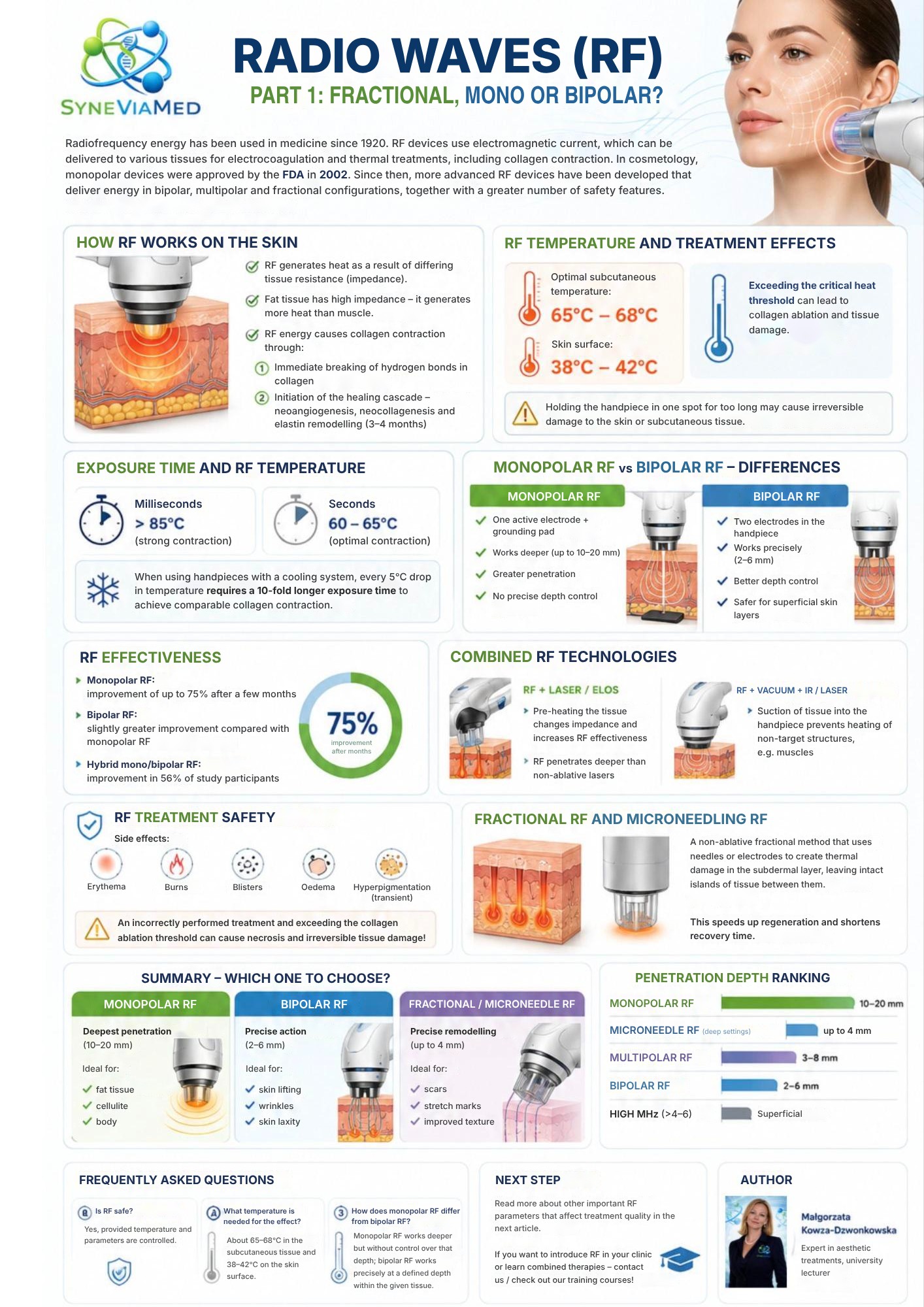
Radiofrequency (RF) Part 1. Fractional, monopolar or bipolar?
Radiofrequency energy has been used in medicine since 1920. RF devices use electromagnetic current, which can be delivered to various tissues for electrocoagulation and thermal treatments, including collagen contraction. In cosmetology, monopolar devices have been approved by the Food and Drug Administration since 2002. Since then, more advanced RF devices have been developed that deliver energy in bipolar, multipolar and fractional configurations, together with a greater number of safety features.
How does RF work on the skin?
RF generates heat as a result of the varying resistance, or impedance, of tissues to electromagnetic current. This means that heat is produced when the natural resistance of tissues converts electrical current into thermal energy, in accordance with Ohm's law.
For example, adipose tissue has high impedance and, over a given period, will generate more heat than muscle, which has lower impedance. Indeed, when RF energy is directed at subcutaneous fat, it has been shown to generate temperatures 7 times higher than those generated in the dermis, leading to fat necrosis while sparing the epidermis.
When RF energy is applied to the skin and soft tissues, it causes contraction through two mechanisms:immediate disruption of hydrogen bonds in the collagen triple helix, causing the collagen fibrils to shorten and thicken, andinitiation of a wound-healing cascade that triggers neoangiogenesis, neocollagenesis and elastin remodelling over the following 3–4 months.
Electron microscopy of collagen heated with RF energy additionally shows the breaking of intramolecular bonds in collagen fibres, which leads to an increase in fibre diameter and shortening of the fibres. Studies of messenger ribonucleic acid (mRNA) also show increased collagen gene expression after treatment.
RF temperature and treatment outcomes
Studies show that optimal contraction requires a subcutaneous temperature of 65°C to 68°C and a skin surface temperature of 38°C to 42°C. Importantly, exceeding the critical thermal threshold can lead to collagen ablation and damage to the entire tissue.
Holding the treatment head in one place for too long can cause irreversible damage to the skin or subcutaneous tissue. The speed at which the head should be moved, or how long the treatment should last within the treatment field, depends on the type of pulses.
Exposure time and RF temperature
With millisecond pulses, the contraction temperature is even above 85°C, whereas for exposures lasting several seconds the contraction temperature lies in the range of 60–65°C. When using heads with a cooling system, every 5°C reduction in temperature requires a 10-fold increase in time to achieve comparable collagen contraction.
Unfortunately, things start to get more complicated, because these established values are altered by both the electrode configuration and the frequency used.
Monopolar vs bipolar RF – the differences
Monopolar devices deliver current via a single active electrode, which transmits electromagnetic current towards a grounding pad.
The overall rate of adverse effects was 2.7% when treatments were performed to reach a target skin surface temperature of 40–42°C; these were rare cases of superficial crusting, minor contour irregularities, erythematous subcutaneous papules, oedema and tenderness. Treatment results reached an improvement of up to 75% months after the end of the treatment course.
Bipolar RF – efficacy and differences
Alexiades-Armenakas et al. compared monopolar/bipolar RF in the treatment of facial wrinkles and laxity. Slightly greater improvement was observed with the bipolar head.
Studies assessing the use of hybrid monopolar/bipolar RF in reducing facial wrinkles and skin laxity showed improvement in 56% of participants.
Combined RF technologies (RF + laser, ELOS)
ELOS photothermolysis/diode lasers are used to pre-heat the target tissues, which in turn alters tissue impedance and susceptibility to RF. RF technology also enables deeper penetration of the dermis than non-ablative lasers, which tend to scatter in soft tissue.
Another combined technology involves vacuum with bipolar RF, often together with infrared (IR) light or a laser. Drawing the tissue into the head makes it possible to avoid heating non-target structures (e.g. muscles).
Safety of RF treatments
The side effects of these treatments are the same as with standard RF and include erythema, burns, blisters, oedema and transient hyperpigmentation. If a treatment is performed incorrectly and the threshold of collagen ablation is exceeded, necrosis and irreversible tissue damage may occur!
Fractional and microneedle RF – how does it work?
A non-ablative fractional radiofrequency method is available that uses needles or electrodes to cause thermal injury to the subcutaneous layer, leaving intact islands of tissue in between. As with fractional laser resurfacing, the untouched areas accelerate the recovery process.
Is RF safe?
Yes, provided that temperature and parameters are controlled.
What temperature is needed for an RF effect?
Approximately 65–68°C in the subcutaneous tissue (body treatments) and 38–42°C at the skin surface.
How does monopolar RF differ from bipolar RF?
Monopolar RF works more deeply, with no control over that depth, whereas bipolar RF acts more precisely at a dedicated depth within the given tissue. The depth of action depends on the spacing of the electrodes.
You will find more about other important RF parameters that affect treatment quality in the next article
If you would like to introduce RF in your clinic or learn combined therapies – contact us / see our training courses
Author: Małgorzata Kowza-Dzwonkowska
Aesthetic treatments expert, university lecturer


