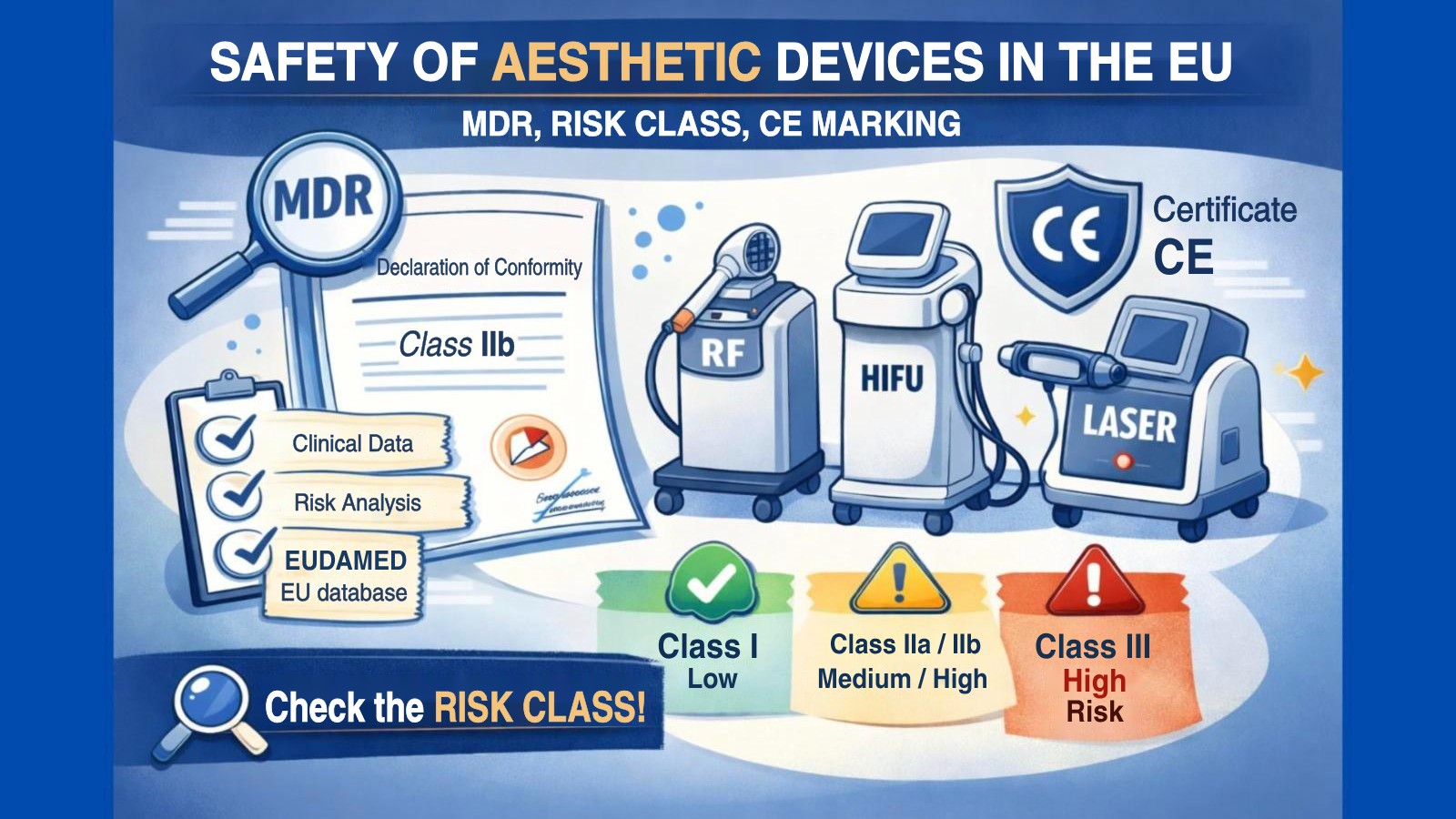
1. What is the MDR – the legal basis
Medical Device Regulation (MDR) 2017/745
This is Regulation (EU) 2017/745 of the European Parliament and of the Council of 5 April 2017 on medical devices.
it applies directly in all EU countries (no transposition required)
2. The key principle of the MDR – “intended purpose” Art. 2(12) MDR – intended purpose
Original (EN):
“intended purpose” means the use for which a device is intended according to the data supplied by the manufacturer
In plain terms: “The intended purpose is the use of the device as specified by the manufacturer on the basis of the information it supplies”
✔ What this means in practice:
It is the manufacturer who decides:
- whether the device is medical
- or aesthetic
not the user, not the doctor, not the cosmetologist
3. When is a device a medical device?
Art. 2(1) MDR
Original (excerpt):
“medical device” means any instrument… intended by the manufacturer to be used… for diagnosis, prevention, monitoring, treatment…
In plain terms: a medical device is a device intended for:
- diagnosis
- prevention
- monitoring
- treatment of disease
✔ Conclusion:
if RF / laser / HIFU:
- treats → it is a medical device
- improves appearance → it is NOT a medical device
Using a “non-medical” device for medical purposes = a breach of the law
Possible consequences:
- an administrative penalty (Polish Medical Devices Act)
- civil liability
- criminal liability (e.g. endangering health – Art. 160 of the Polish Criminal Code, KK)
If the device is a medical device:
✔ it must have:
- CE marking
- a conformity assessment
- clinical documentation
- a quality management system
✔ the user (e.g. a clinic):
- must use it in line with its intended purpose (Art. 10 MDR)
4. Aesthetic devices under the MDR
Art. 1(2) + Annex XVI
Original (meaning):The MDR also covers: products without a medical purpose that act on the body
✔ Annex XVI includes, among others:
- lasers and IPL for skin treatments
- energy-emitting devices
✔ Conclusion:
aesthetic devices:
- are not medical
- but are subject to the MDR (safety! CE)
5. Device classification (risk) Art. 51 MDR
Devices are divided into classes:
- I
- IIa
- IIb
- III
Annex VIII – Rule 9
Applies to energy-emitting devices:
Original:
active therapeutic devices intended to administer or exchange energy
In plain terms: active devices that deliver energy to the body
✔ Examples:
- RF
- laser
- HIFU
✔ Significance:
the higher the risk class:
- the greater the oversight
- the more demanding the certification
6. How a device is registered in the EU (procedure)
Step 1 – defining the intended purpose
The manufacturer defines:
- the medical / aesthetic purpose
- the indications
Step 2 – classification
Based on:👉 Annex VIII of the MDR
Step 3 – conformity assessment Art. 52 MDR
Original:
devices shall undergo a conformity assessment
👉 the device must undergo a conformity assessment
✔ for class:
- I → the manufacturer carries out the assessment itself
- IIa / IIb / III → a notified body
Step 4 – technical documentation Annex II MDR
Requires:
- a description of the device
- a risk analysis
- clinical data
Step 5 – CE marking Art. 20 MDR
CE means:
- compliance with the MDR
- authorisation to be placed on the market
Step 6 – registration in EUDAMED Art. 29 MDR
the device is entered in the EU database and can be looked up
7. What MDR certification means
✔ the device:
- is safe
- has defined parameters
- has been assessed
BUT:
- it does not determine who may use it
8. The MDR, VAT and intended purpose
VAT depends on classification as a medical device
✔ In Poland:
- medical device → 8% VAT
- aesthetic device → 23% VAT
✔ Conclusion:
👉 it is the intended purpose (MDR) that affects:
- VAT
- the application
- the market
9. Key takeaways
✔ The MDR regulates:
- safety
- risk classes
- certification
- clinical data
The MDR does NOT regulate:
- who performs the treatment
- whether it must be a doctor
- professional competences


