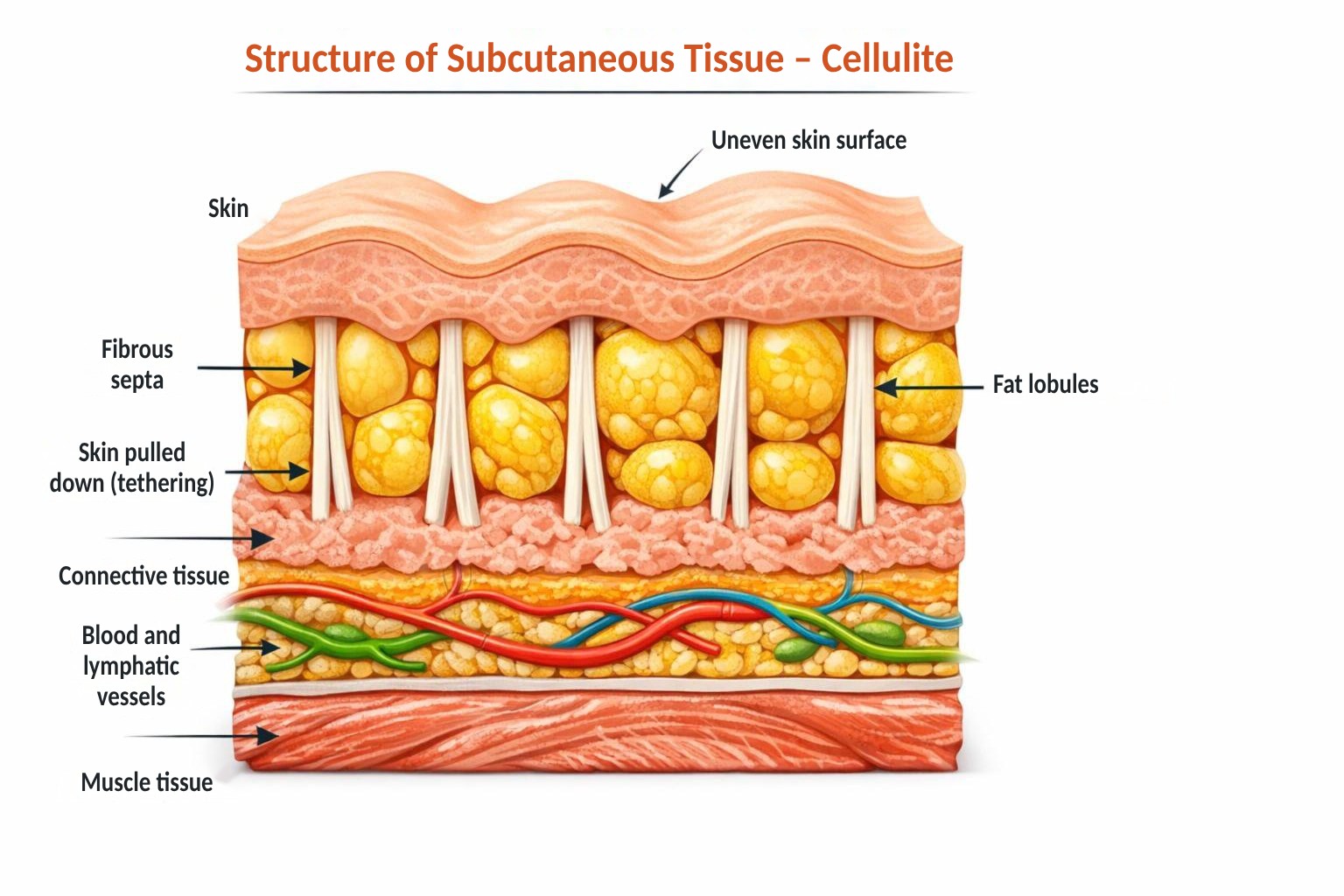
Cellulite – a disorder of tissue architecture, not just an “aesthetic problem”
Why does cellulite develop and why is it so hard to get rid of?
Cellulite is not merely a superficial aesthetic change but, above all, a disorder of the architecture of the subcutaneous tissue. It arises from the interaction of mechanical, metabolic, vascular and hormonal factors, which lead to characteristic structural changes visible on the surface of the skin.
The key mechanism: changes in the structure of the fibrous septae
The most important factor in the pathogenesis of cellulite in women is fibrosis and shortening of the connective-tissue septae (fibrous septae).
What does this mean in practice?
- the fibrous septae pull the skin downwards (tethering)
- at the same time, the fat lobules bulge upwards
- the characteristic picture emerges:irregularities, dimples and “orange peel skin”
This mechanism has been well described in both classic and modern imaging studies, including byNürnberger and Müller and Querleux et al..
Why does cellulite mainly affect women?
The key difference lies in the structure of the subcutaneous tissue:
- in women, the septae are oriented more vertically
- in men, they have an oblique, criss-cross arrangement
Result:
- in women, it is easier for fat to be pushed upwards
- in men, the structure is more mechanically stable
This explains why cellulite:
- mainly affects women after puberty
- is rare in men (usually associated with hormonal disorders)
The role of microcirculation and inflammation
Cellulite is not only about mechanics – changes in microcirculation also play an important role:
- impaired venous and lymphatic flow
- increased vascular permeability
- a tendency towards interstitial oedema
- impaired metabolic exchange
this leads to:
- tissue hypoxia
- chronic low-grade inflammation
- increased fibrosis
These phenomena have been widely described, including byRossi and Vergnanini andRawlings.
The importance of hormones and adipose tissue
Oestrogens play a key role through their influence on:
- the distribution of adipose tissue
- vascular permeability
- the metabolism of the extracellular matrix (ECM)
- fluid retention
in addition:
- increased adipocyte volume (hypertrophy)
- places greater pressure on the fibrous septae
Age and skin quality
With age, there is:
- a decrease in collagen content
- a deterioration in the biomechanical properties of the skin
- a weakening of the dermal “scaffolding”
result:
- irregularities become more visible
- cellulite becomes entrenched
Summary – the main causes of cellulite
Cellulite is the result of several key processes occurring together:
1. 🔹 Disrupted architecture of the subcutaneous tissue (the key factor)
- fibrosis and shortening of the septae
2. 🔹 Adipocyte hypertrophy
- increased volume of adipose tissue
3. 🔹 Microcirculatory disorders
- oedema, hypoxia, inflammation
4. 🔹 Fibrosis and stiffness of the septae
- consolidation of the deformities
5. 🔹 Hormonal factors (oestrogens)
- especially in women
6. 🔹 Age and collagen degradation
- deterioration in skin quality
What does this mean for treatment?
Understanding the mechanism leads to a key conclusion:
the most effective methods are those that act directly on the fibrous septae
Why?
If the dominant features are:
- pronounced tethering dimples
- changes visible at rest
then the problem does NOT concern fat alone, but: the mechanical pulling of the skin by the septae
The most biologically rational methods
The strongest and most durable results are achieved by technologies that:
✔️ cut or release the fibrous septae✔️ change the architecture of the tissue
The best documented include:
- subcision (e.g. Cellfina)
- Nd:YAG laser
- Radiofrequency
- HIFU
- ultrasound lipolysis
- shockwave therapy (ESWT)
- acoustic / radial wave therapy
- acoustic subcision
- mechanical and vacuum massage
Key conclusion
Cellulite is a structural problem, not just an adipocyte one
Therefore:
- reducing adipose tissue alone is often NOT enough
- it is necessary to act on:
- the fibrous septae
- microcirculation
- skin quality
Summary
Effective cellulite treatment requires:
- identifying the dominant mechanism
- matching the technology to the tissue structure and type of cellulite
- ideally, the use of combined therapies
Only a combination of several treatments delivers real and lasting clinical results
Małgorzata Kowza-Dzwonkowska
University lecturer, cosmetologist, dietitian, therapist, biomedical chemist


