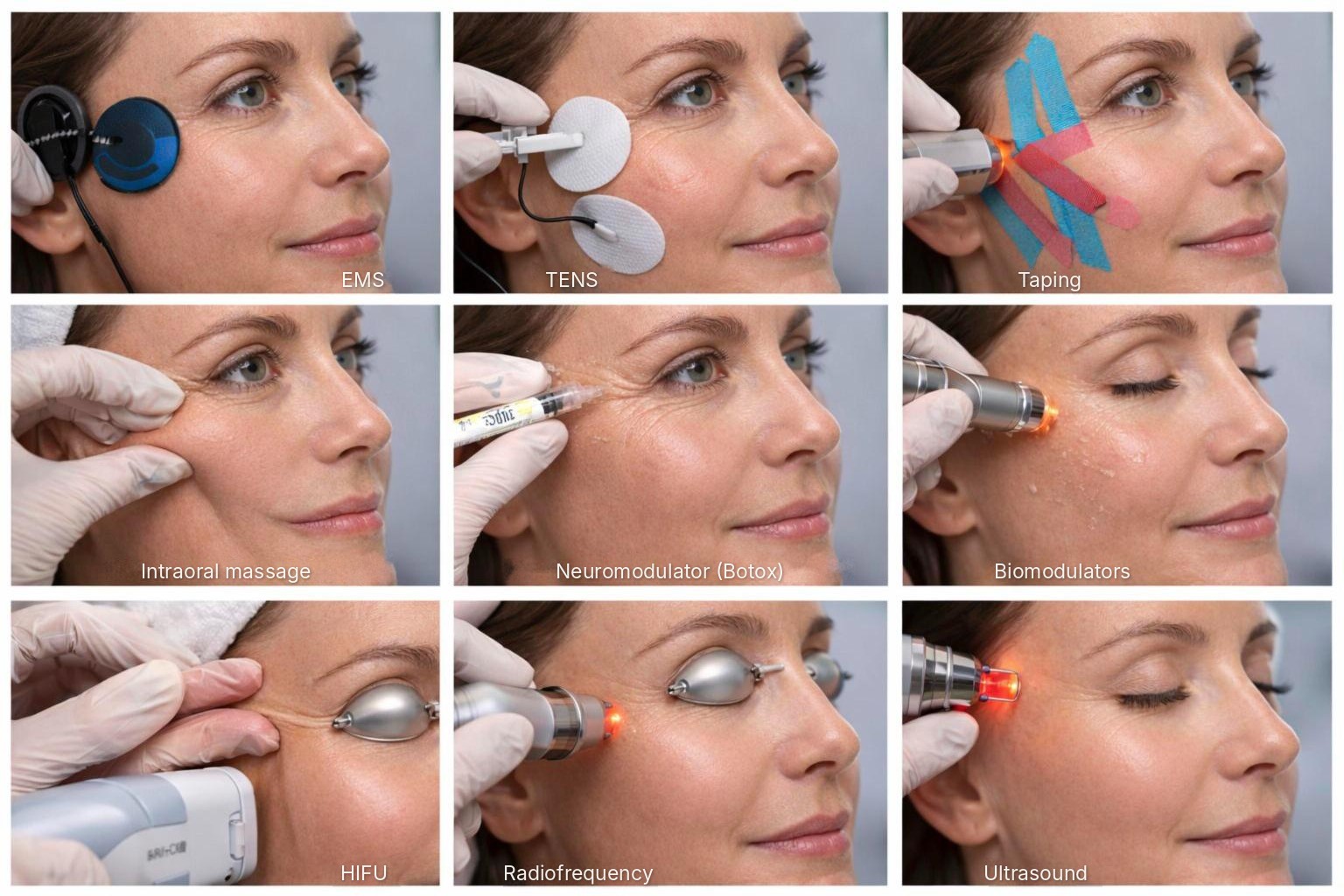
With age, not only does the skin lose firmness, but the tension and relationships within the retaining ligaments and the continuity of the fascio-muscular structures of the face also change. This promotes descent of the soft tissues and deepening of folds [5,6].In practice, this means that a cream alone will not reverse changes resulting from the mechanics of the deep tissues.
1.6. Muscles of facial expression
The muscles of facial expression contribute to the formation of dynamic wrinkles, which over time become fixed as static wrinkles. Repeated contraction of the muscles of the forehead, glabella or periorbital area is superimposed on declining skin elasticity and the loss of supportive collagen [15,16].This is why some signs of ageing are mechanical and muscular in nature, rather than purely cutaneous.
The role of the muscles of facial expression is twofold. On the one hand, years of repetitive contractions generate dynamic wrinkles and fix static lines. On the other, the muscles remain an integral part of the facial architecture and influence the tension and position of the tissues
Repetitive activity of the muscles of facial expression plays a key role in the formation of dynamic wrinkles, which over time become static [17,18]. Some muscles show functional hypertrophy, while others show weakening of the balance of force vectors. This is particularly relevant to the glabella, forehead, periorbital area and lower face.
The facial muscles age differently from classic postural or limb muscles. This stems from their particular anatomy: many of them insert directly into the skin rather than only into bone, so any change in the tone, volume or quality of a muscle is immediately reflected in the facial contours, wrinkle formation and tissue descent [9–11]. For this reason, ageing of the muscles of facial expression should be analysed not in isolation but as part of a multilayered system comprising the skin, fat, SMAS, retaining ligaments and the bony framework [6–11].
As a result of the decline in muscle mass, quality and function, stemming from, among other things, loss of motor units, innervation disorders, impaired regeneration and mitochondrial changes, some fibres weaken and imbalances in tension develop between individual muscles of facial expression. Clinically, this may result in the coexistence of overactivity in some muscle groups and weakness in others [1–3].
Muscle condition is indirectly affected by photoageing, which accentuates the visible effects of muscle ageing through loss of elasticity, deterioration of the dermal-fascial scaffold and increased laxity. Changes in skin structure mean that the muscles of facial expression work against an increasingly less elastic supporting tissue. The spatial relationships between fat, skin and muscle also change [5]. Changes in the structure of the SMAS, fascia and bone impair the support for muscles and skin, and clinically this manifests as sagging and a loss of harmony in facial movement.
Given how complex the problem is, there is no single method that effectively “rejuvenates the facial muscles”. The best results are achieved when therapy is tailored to: muscle overactivity, volume loss, skin laxity, weakening of the supporting structures or remodelling of the deeper layers [4–17].
Which methods are most effective, depending on the dominant problem
When the dominant problem is overactivity of the muscles of facial expression, the best-documented method remains botulinum toxin type A [10,11].
When the dominant problem is loss of volume and muscle support, the strongest rationale exists for hyaluronic acid fillers [4–8,14].
When the dominant problem is laxity of the deeper layers and weakening of the SMAS, the most rational choices are microfocused ultrasound and radiofrequency [9,13,14].
When the dominant problems are static wrinkles and photodamage of the skin overlying the muscle, high value is offered by fractional lasers and microneedling [15–17].
The best aesthetic outcome therefore usually comes from combination therapy, because each of these treatments acts primarily on a different layer or a different component of ageing [4–18].
Małgorzata Kowza-Dzwonkowska
University lecturer, cosmetologist, dietitian, therapist, biomedical chemist
Bibliography
[1] Larsson L, Degens H, Li M, Salviati L, Lee YI, Thompson W, Kirkland JL, Sandri M. Sarcopenia: Aging-Related Loss of Muscle Mass and Function. Physiological Reviews. 2019;99(1):427-511.
[2] Lexell J. Human aging, muscle mass, and fiber type composition. The Journals of Gerontology Series A: Biological Sciences and Medical Sciences. 1995;50 Spec No:11-16.
[3] Narici MV, Maffulli N. Sarcopenia: characteristics, mechanisms and functional significance. British Medical Bulletin. 2010;95:139-159.
[4] Rohrich RJ, Pessa JE. The fat compartments of the face: anatomy and clinical implications for cosmetic surgery.Plastic and Reconstructive Surgery. 2007;119(7):2219-2227.
[5] Lambros V. Observations on periorbital and midface aging. Plastic and Reconstructive Surgery. 2007;120(5):1367-1376.
[6] Shaw RB Jr, Katzel EB, Koltz PF, Kahn DM, Langstein HN, Girotto JA. Aging of the facial skeleton: aesthetic implications and rejuvenation strategies. Plastic and Reconstructive Surgery. 2011;127(1):374-383.
[7] Ghassemi A, Prescher A, Riediger D, Axer H. Anatomy of the SMAS revisited. Aesthetic Plastic Surgery.2003;27(4):258-264.
[8] Yaar M, Gilchrest BA. Photoageing: mechanism, prevention and therapy. British Journal of Dermatology.2007;157(5):874-887.
[9] Pessa JE. An algorithm of facial aging: verification of Lambros’s theory by three-dimensional stereolithography, with reference to the pathogenesis of midfacial aging, scleral show, and lateral suborbital trough deformity. Plastic and Reconstructive Surgery. 2000;106(2):479-488.
[10] Carruthers JD, Carruthers JA. Treatment of glabellar frown lines with C. botulinum-A exotoxin. Journal of Dermatologic Surgery and Oncology. 1992;18(1):17-21.
[11] Carruthers A, Carruthers J. Cosmetic use of botulinum toxin. Dermatologic Clinics. 2004;22(2):151-160.
[12] Sundaram H, Cassuto D. Biophysical characteristics of hyaluronic acid soft-tissue fillers and their relevance to aesthetic applications. Plastic and Reconstructive Surgery. 2013;132(4 Suppl 2):5S-21S.
[13] Suh DH, Shin MK, Lee SJ, Rho JH, Kim NI. Intense focused ultrasound tightening in Asian skin: clinical and pathologic results. Dermatologic Surgery. 2011;37(11):1595-1602.
[14] Fitzpatrick R, Geronemus R, Goldberg D, Kaminer M, Kilmer S, Ruiz-Esparza J. Multicenter study of noninvasive radiofrequency for periorbital tissue tightening. Lasers in Surgery and Medicine. 2003;33(4):232-242.
[15] Manstein D, Herron GS, Sink RK, Tanner H, Anderson RR. Fractional photothermolysis: a new concept for cutaneous remodeling using microscopic patterns of thermal injury. Lasers in Surgery and Medicine. 2004;34(5):426-438.
[16] Hantash BM, Bedi VP, Kapadia B, Rahman Z, Jiang K, Tanner H, Chan KF, Zachary CB. In vivo histological evaluation of a novel ablative fractional resurfacing device. Lasers in Surgery and Medicine. 2007;39(2):96-107.
[17] Aust MC, Reimers K, Repenning C, Stahl F, Jahn S, Guggenheim M, et al. Percutaneous collagen induction therapy: an alternative treatment for scars, wrinkles, and skin laxity. Plastic and Reconstructive Surgery.2008;121(4):1421-1429.


