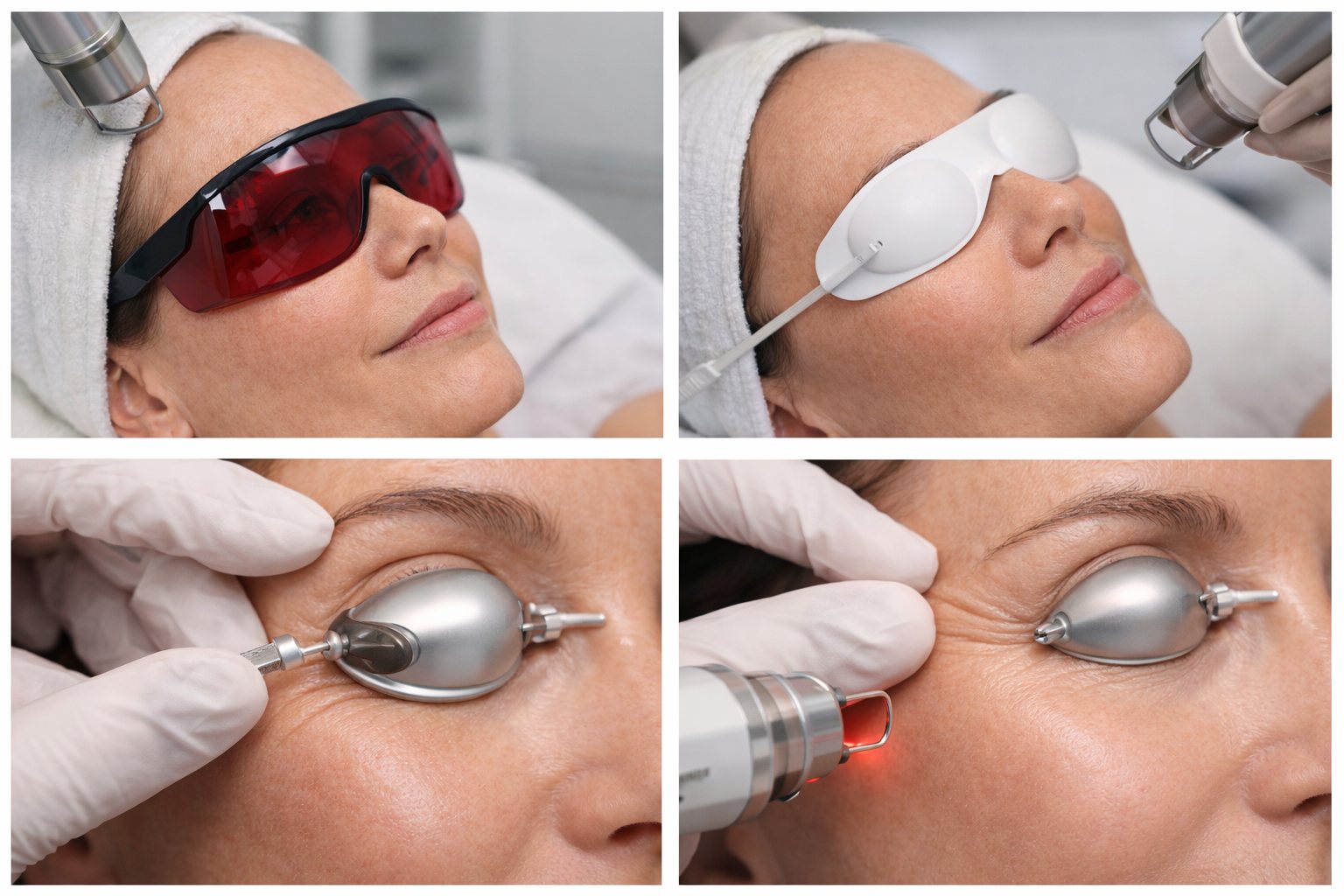
How to protect the eyeball during aesthetic treatments.
Knowing the risks improves safety
Fractional CO₂ / Er:YAG laser on the eyelid
The safest approach is to use:
- an internal corneal shield - metal
- plus standard ophthalmic and laser protection rules
- This is one of the situations in which simply closing the eye is not enough.
IPL near the eye
Requires particular caution. Ocular complications after IPL and lasers have been described in the literature when protection was inadequate.The most commonly used measures are:
- appropriate external or internal shields, depending on the area
- strictly avoiding emission towards the pupil and through the thin eyelid
HIFU / MFU-V
There is no light exposure as with a laser, but the eye still needs to be protected by:
- strictly avoiding the orbit
- the correct depth
- not directing the energy focus towards the eyeball
- A mechanical eye shield may be used depending on the procedure, but knowledge of anatomy and technique is key.
Microneedling RF / microneedling
The most important factors are:
- distance from the eyelid margin
- the correct depth
- avoiding any direction towards the eyeballIn these procedures an internal shield is not always standard, but very close to the eye it may be considered according to the protocol and the operator’s experience.
Electrical stimulation
Does not require typical laser shields, but the electrodes should not be placed so that current passes through the eyeball. This requires appropriate electrode geometry and a low ophthalmic risk.
RISKS
Lasers
Corneal burns, iris damage, posterior synechiae, uveitis, cataract and other complications resulting from improper use of lasers near the eye have been described in the literature. The highest-risk situations are:
- lack of appropriate ophthalmic shields,
- relying solely on eyelid closure,
- excessive energy during eyelid treatment,
- lack of knowledge of the wavelength and energy penetration,
- treatment performed too close to the lash line without protection.
HIFU and RF
Here the risk of eye injury is lower than with direct laser exposure, but anatomically it is still not zero. The following are required:
- the correct depth,
- the correct direction of treatment lines,
- avoiding the orbit and at-risk structures,
- extensive operator experience.
Botulinum toxin
The most common adverse effects are functional rather than intraocular:
- ptosis,
- asymmetry,
- dryness or transient blinking disturbance with poor technique.
Microneedling and manual treatments
The ophthalmic risk is usually indirect and related to incorrect technique, infection, irritation or encroaching too close to the lash line.
Małgorzata Kowza-Dzwonkowska
University lecturer, cosmetologist, dietitian, therapist, biomedical chemist


