BoNT-A
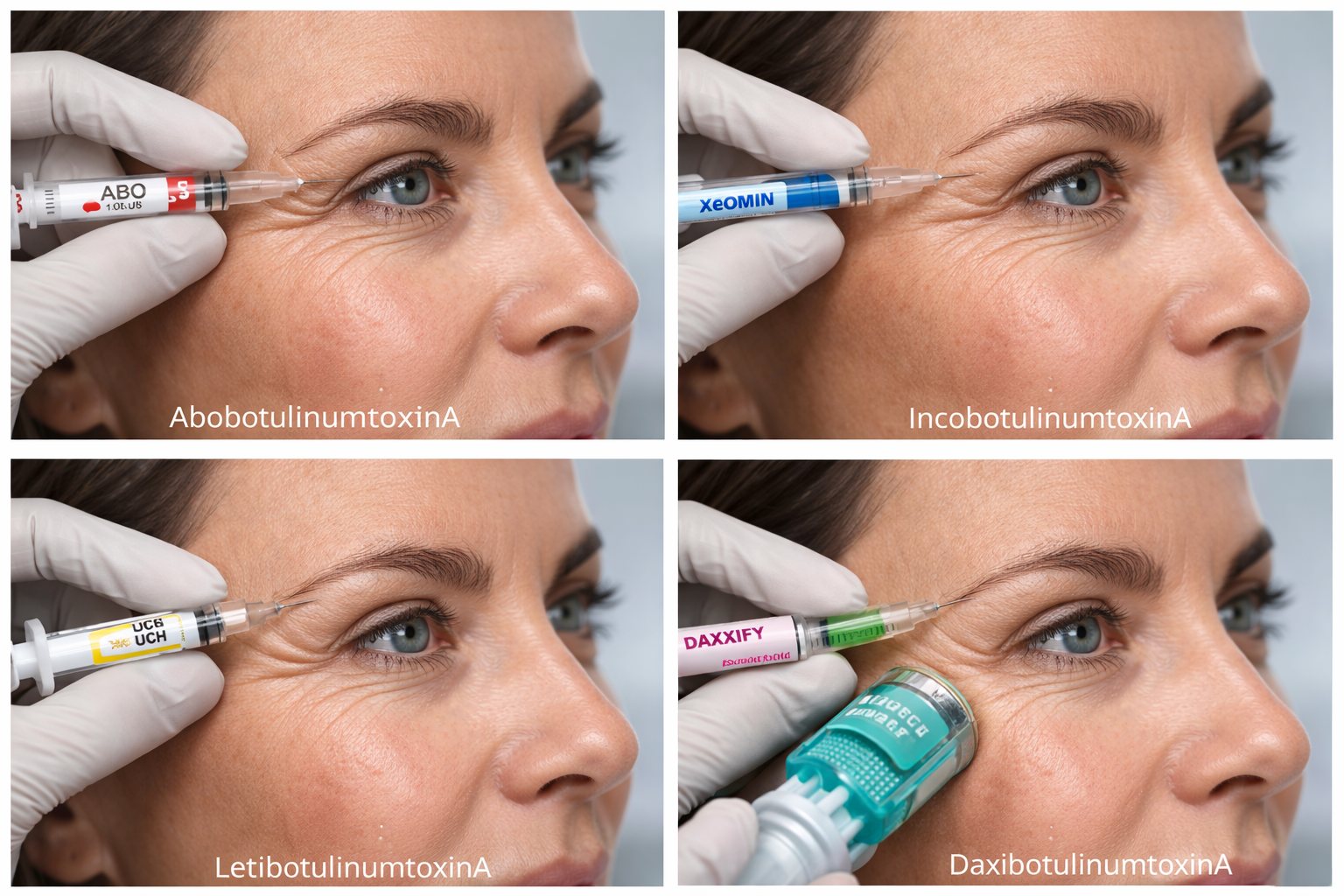
The best-documented neuromodulators with an action similar to BTX-A are: abobotulinumtoxinA, incobotulinumtoxinA (Xeomin), as well as some newer products such as letibotulinumtoxinA and nivo-/prabotulinumtoxinA; for daxibotulinumtoxinA (DAXI)the data are promising, particularly regarding duration of effect.
The strongest scientific evidence indicates that BoNT-A products other than Botox are effective in treating lateral canthal lines (LCL, crow’s feet). A randomised study by Lowe et al. showed that BoNT-A is safe and effective in reducing crow’s feet, and 12 U per side was considered the most appropriate dose in that study protocol
In a randomised comparison of letibotulinumtoxinA and onabotulinumtoxinA, a marked improvement was observed at week 4 in 69.75% of the letibotulinumtoxinA group and 68.33% of the onabotulinumtoxinA group, with no significant difference between the groups. This is important evidence that at least some neuromodulators other than Botox can produce a comparable clinical effect in this area
Injectable BoNT-A neuromodulators such as abobotulinumtoxinA, incobotulinumtoxinA i letibotulinumtoxinA have documented clinical efficacy in this area, and the differences between them relate mainly to unit doses, speed of onset, duration of effect and formulation characteristics.
When assessing efficacy, we draw a clear line between marketing and the strength of scientific evidence. The literature includes studies on neurotransmitter inhibitor peptides, such as acetyl hexapeptide-8 (Argireline) and related peptides, but their efficacy is clearly more modest than that of injectable BoNT-A, and the key problem remains skin permeability.
Promising, however, are the clinical results of Wang et al., who demonstrated the efficacy of Argireline in treating periorbital wrinkles in a clinical study, while a 2023 randomised trial using AHP-3 i PPP-4 in patients with crow’s feet also showed an anti-ageing effect. These results are interesting, but their effect size is not comparable with that of injectable neuromodulators. Supporting Argireline with modern active-ingredient delivery methods such as iontophoresis, plasma, electroporation and others may improve treatment efficacy. Enhancing peptide penetration and using an appropriate carrier and delivery system are the key to greater efficacy.
BTX-A
Lateral canthal lines (“crow’s feet”) are a classic example of expression lines resulting from chronic activity of the orbicularis oculi muscle. Numerous randomised studies have shown that botulinum toxin type A (BTX‑A) is effective and safe in reducing their severity.
In the classic split‑face study by Lowe et al., patients received 6, 12 or 18 units of BTX‑A into the orbicularis oculi on one side and placebo on the other. All BTX‑A doses were significantly more effective than placebo in reducing wrinkles at maximum smile and at rest for up to 16 weeks, with no clear dose–response relationship above 12 U/side.
A multicentre phase III study compared the new product letibotulinum toxin A with onabotulinum toxin A in 240 people with moderate-to-severe crow’s feet. At week 4, the response rate (reduction in wrinkle severity to mild or none) was 69.75% for LeBA and 68.33% for OnBA, with no significant differences between the products and a similar safety profile.
Randomised, double-blind studies with type B toxin (Myobloc) confirmed that this type of toxin can also effectively reduce periorbital wrinkles, albeit with a different adverse-event profile (e.g. more frequent dry mouth).
Extent of tissue action and safety: Botulinum toxin acts selectively on the neuromuscular junction of the orbicularis oculi, reducing its activity and thus the number of skin “folds”. Clinical studies have shown no permanent ophthalmic complications with correct technique (injections at a safe distance from the orbital rim, avoiding lower-eyelid injections in patients with laxity).
Małgorzata Kowza-Dzwonkowska
University lecturer, cosmetologist, dietitian, therapist, biomedical chemist
Bibliography
- Ascher B, Rzany BJ, Grover R. Efficacy and safety of botulinum toxin type A in the treatment of lateral crow's feet: double-blind, placebo-controlled, dose-ranging study. Dermatol Surg. 2009;35(10):1478-1486. PMID: 19686365.
- Lowe NJ, Ascher B, Heckmann M, et al. Double-blind, randomized, placebo-controlled, dose-response study of the safety and efficacy of botulinum toxin type A in subjects with crow's feet. Dermatol Surg. 2005;31:257-262. PMID: 15841623.
- Kerscher M, Rzany B, Prager W, et al. Efficacy and Safety of IncobotulinumtoxinA in the Treatment of Upper Facial Lines: Results From a Randomized, Double-Blind, Placebo-Controlled, Phase III Study. Dermatol Surg. 2015. PMID: 26359996.
- Joseph J, Sudimac V, Mersmann S, Kerscher M. IncobotulinumtoxinA in the Treatment of Upper Facial Lines: Results From Two Randomized, Double-Blind, Placebo-Controlled, Phase III Studies. Aesthet Surg J.2025;45(3):293-304. PMID: 39475143.
- Pavicic T, et al. Aesthetic Improvements Over Time: Long-Term Efficacy of IncobotulinumtoxinA for Simultaneous Treatment of Upper Facial Lines. J Cosmet Dermatol. 2025. PMID: 40968493.
- Yoo KH, et al. Randomized, double-blind, active-controlled, multicentre, phase III trial comparing letibotulinumtoxinA with onabotulinumtoxinA for crow’s feet lines. J Eur Acad Dermatol Venereol. 2021. PMID: 33721365.
- [Authors as per PubMed record]. NivobotulinumtoxinA in the Treatment of Glabellar Lines Alone or With Lateral Canthal Lines. Aesthet Surg J. 2025. PMID: 39587780.
- Dover JS, et al. Treatment of Upper Facial Lines With DaxibotulinumtoxinA for Injection: Results From an Open-Label Phase 2 Study. Aesthet Surg J. 2023. PMID: 36533798.
- Lemdani MS, et al. Comparison of Botulinum Toxin A Formulations in upper facial rhytids. JAMA Dermatol.2025. PMID: 40434770.
- Camargo CP, et al. Botulinum toxin type A for facial wrinkles. Cochrane Database Syst Rev. 2021. PMID: 34224576.
- Erickson BP, Lee WW. The role of neurotoxins in the periorbital and midfacial areas. Curr Opin Ophthalmol.2015. PMID: 25921574.
- Zimbler MS, Kokoska MS, Thomas JR. Effect of botulinum toxin pretreatment on laser resurfacing results: a prospective, randomized, blinded trial. Arch Facial Plast Surg. 2001. PMID: 11497500.
- Coleman KR, Grover R. Combination therapy with BOTOX and fillers: the new rejuvenation paradigm.Dermatol Ther. 2006. PMID: 16784517.
- Landau M. Combination of chemical peelings with botulinum toxin and dermal fillers for facial rejuvenation.J Cosmet Dermatol. 2006. PMID: 17173585.
- Narurkar VA, et al. A Comprehensive Approach to Multimodal Facial Aesthetic Treatment. Dermatol Surg.2016. PMID: 27128246.
- Park JY, et al. A multimodal approach combining botulinum toxin, fillers and energy-based devices for facial rejuvenation. J Cosmet Dermatol. 2020. PMID: 31697448.
- Mortazavi SM, et al. Skin permeability, a dismissed necessity for anti-wrinkle peptides. Int J Pharm. 2022. PMID: 35302659.
- Wang Y, et al. The anti-wrinkle efficacy of argireline, a synthetic hexapeptide, in peri-orbital wrinkles. Int J Cosmet Sci. 2013. PMID: 23417317.
- Aruan RR, et al. Double-blind, randomized trial of AHP-3 and PPP-4 in patients with crow’s feet. Skin Res Technol. 2023. PMID: 36909866.
- Lim SH, et al. Enhanced Skin Permeation of Anti-wrinkle Peptides via Chemical Modification. Sci Rep. 2018. PMID: 29371611.
- Choi YL, et al. Dermal Stability and In Vitro Skin Permeation of Collagen Pentapeptides KTTKS and Pal-KTTKS. Biomol Ther. 2014. PMID: 25143811.


