  • Internationally recognised certificates
  • Programmes for specialists and doctors
  • The latest treatment technologies
  • Premium quality in every detail
  • Our own combination treatment protocols
Products in the cart: 0. See details
English / €

New technologies in the fight against cellulite

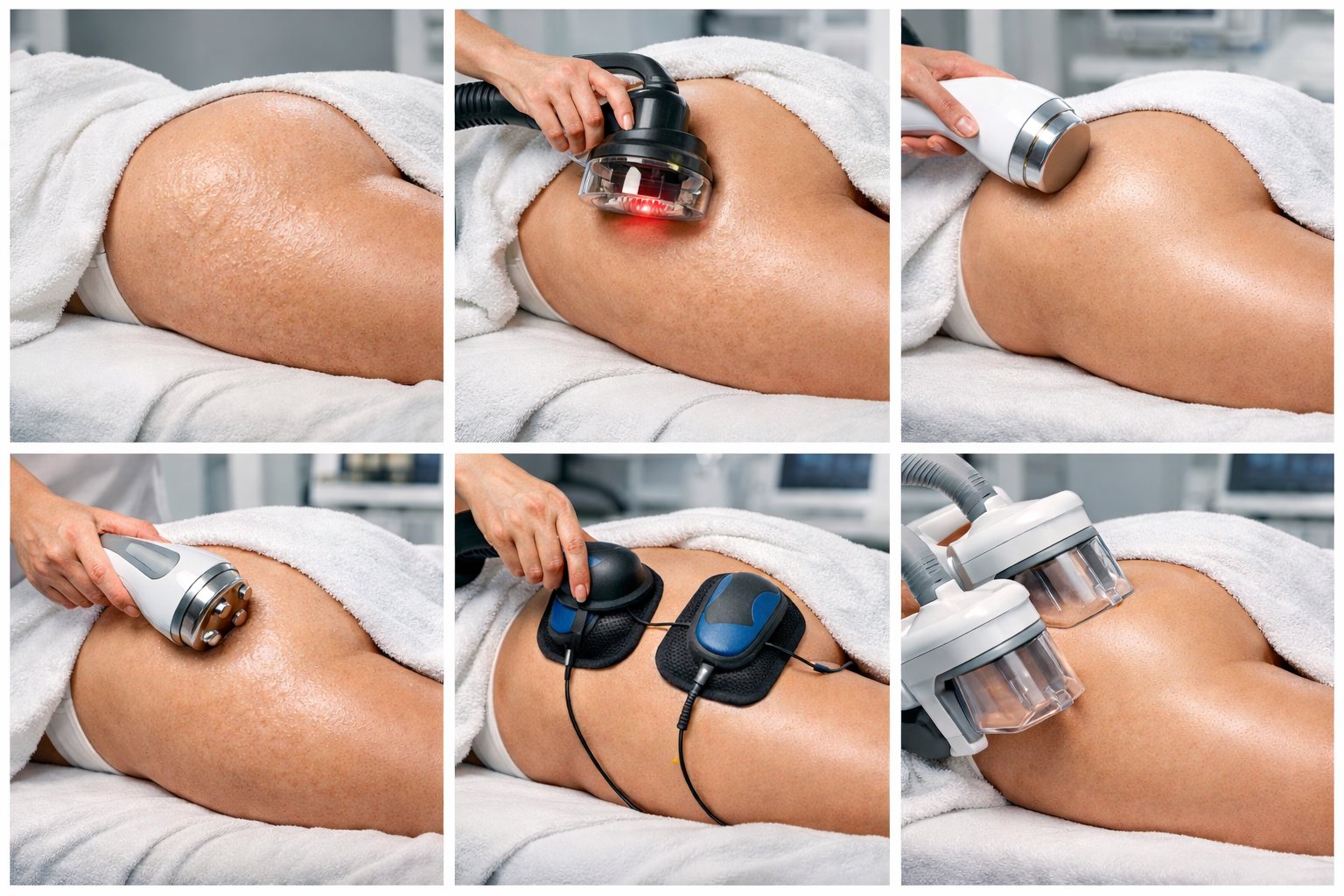
Modern technologies used in cellulite reduction

Cellulite, commonly known as “orange peel skin”, is an extremely common condition. It is estimated to affect 85–98% of post-pubertal women. It results from changes in the subcutaneous adipose tissue and connective tissue fibres, together with impaired microcirculation. As a result, characteristic dimples and an uneven surface appear on the skin, most often on the thighs, buttocks and hips.

Traditional methods such as massage or diet alone can help improve the appearance of the skin, but their effects are usually limited. This is why practitioners increasingly turn to modern in-clinic treatment technologies, whose efficacy is being evaluated in clinical studies.

Below we present the most important methods currently used in cellulite therapy.


Radiofrequency (RF) and microneedle radiofrequency

One of the most widely used technologies is radiofrequency, a treatment that uses radio-wave energy to heat the deeper layers of the skin. This leads to:

  • improved skin firmness

  • stimulation of collagen production

  • improved microcirculation

  • reduced visibility of cellulite.

Clinical studies have observed an improvement in skin structure and a reduction in adipose tissue thickness after a series of treatments. Many patients also showed a reduction in thigh circumference and a visibly smoother skin surface.


Ultrasound therapy (HIFU, LDM)

Technologies based on ultrasound work in the deeper layers of the skin and adipose tissue.

The most commonly used are:

HIFU – high-intensity focused ultrasound, which can support fat reduction and improve skin firmness.

LDM (local dynamic ultrasound therapy) – a method using different ultrasound frequencies that act on the structure of the dermis and subcutaneous tissue.

Studies show that these treatments can improve skin firmness and smooth the boundary between the skin and the adipose tissue, which reduces the visibility of cellulite.


Low-level laser therapy (LLLT)

LLLT is a method that uses low-energy laser light. The treatment aims to:

  • improve the metabolism of fat cells

  • stimulate microcirculation

  • improve skin elasticity.

In clinical studies, some patients noticed reduced visibility of cellulite and an improvement in the appearance of their skin after several sessions.


Shockwave therapy

Extracorporeal shockwave therapy (ESWT) is a technology also used in physiotherapy. In cellulite treatment it works by:

  • improving circulation

  • loosening the fibrous septa in the subcutaneous tissue

  • stimulating regenerative processes.

Studies show that a series of treatments can reduce the grade of cellulite and improve the appearance of the skin.


New technologies and directions in therapy

In recent years, other methods supporting cellulite therapy have also been developed, including:

  • high-frequency ultrasound

  • acoustic technologies that loosen connective tissue fibres

  • combining several technologies within a single treatment plan.

The aim of these methods is to act simultaneously on the different causes of cellulite: adipose tissue, the dermis and microcirculation.


Good to know

Cellulite is a complex condition, and the best results usually come from combining several methods, e.g.:

  • device-based treatments

  • physical activity

  • appropriate skincare.

Modern technologies do not replace a healthy lifestyle, but they can significantly improve the appearance of the skin and reduce the visibility of cellulite.


Małgorzata Kowza-Dzwonkowska

University lecturer, cosmetologist, dietitian, therapist, biomedical chemist

  • author: Małgorzata Kowza-Dzwonkowska
  • added: 16-03-2026
New technologies in the fight against cellulite


What combination therapy for cellulite involves.

Combination therapy involves combining several different treatment methods, each acting on a different element of the cellulite problem.

For example, one technology may:

  • improve skin firmness

  • reduce adipose tissue

  • stimulate microcirculation

  • support lymphatic drainage.

This produces a synergistic effect, in which the individual therapies reinforce one another.

What clinical studies show

Many studies assessing the efficacy of combination therapies have already been described in the medical literature.

Combining RF, shockwave therapy and cryotherapy

A clinical study showed a significant improvement in the appearance of the skin and a reduction in cellulite and oedema after a series of treatments combining:

  • radiofrequency (RF)

  • shockwave therapy (ESWT)

  • cryotherapy.

In this protocol each technology has a different role:

  • RF heats the tissues and stimulates collagen production

  • shockwave therapy supports regeneration and improves microcirculation

  • cryotherapy boosts metabolism and lymphatic drainage.

Patients reported higher satisfaction compared with single-method therapy.


Radiofrequency + vacuum + infrared + massage

Another study used a combination of:

  • bipolar radiofrequency

  • vacuum therapy

  • infrared radiation

  • manual massage.

After a series of 8–12 treatments, improved microcirculation and remodelling of the dermis were observed. In many participants the cellulite grade decreased by 1–2 grades on the clinical scale.


Shockwave therapy combined with physical activity

Meta-analyses also indicate that shockwave therapy used together with physical exercise produces better results than the therapy alone.

In some studies the cellulite grade decreased by as much as 50–80%, and the results lasted for several months.


Examples of modern combination treatments

In clinical practice, various combinations of technologies and manual methods are often used.

Microneedle RF + HIFU

Combining technologies that act at different skin depths can improve skin firmness and support fat reduction.

LLLT + vacuum massage

Low-level laser supports fat-cell metabolism, while vacuum massage improves circulation and lymphatic drainage.

Shockwave therapy + carboxytherapy

Combining these methods can improve tissue blood supply and support skin regeneration.

RF + cryolipolysis

One technology targets adipose tissue while the other improves skin firmness, so the results can be more visible.

Choosing the right types of treatment, in the right order and at the right frequency, combined with home skincare, delivers outstanding results. 


Why combination therapies work better

Combining several methods makes it possible to address different elements of the problem at the same time:

  • reducing adipose tissue

  • improved skin firmness

  • loosening fibrous structures

  • improved microcirculation

  • supporting lymphatic drainage.

As a result, the effects can be more comprehensive and longer-lasting.


What to know before starting therapy

A treatment plan should always be tailored individually to:

  • the grade of cellulite

  • the condition of the skin

  • lifestyle

  • the patient’s expectations.

The best results are usually achieved by combining in-clinic treatments with a healthy lifestyle and physical activity.


We will be happy to advise you on choosing the best equipment and devices. We warmly invite you to our training courses.


Małgorzata Kowza-Dzwonkowska

University lecturer, cosmetologist, dietitian, therapist, biomedical chemist

  • Evidence-based knowledge
    Evidence-based knowledge
  • International courses
    International courses
  • Online courses
    Online courses
  • Safe treatment protocols
    Safe treatment protocols
  • Proven, effective protocols
    Proven, effective protocols
  • Professional development at the highest level
    Professional development at the highest level